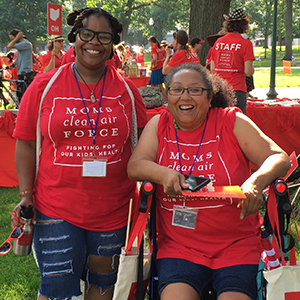

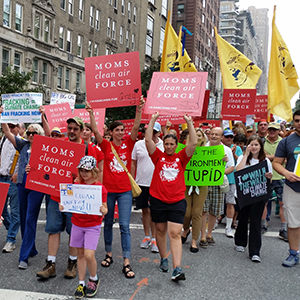
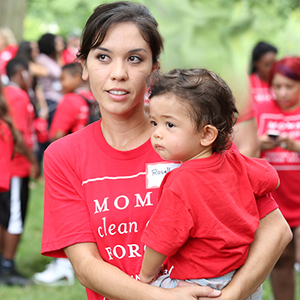


This week, as #MomsSummerof Action continues, dozens of Moms’ staff and members from states across the country are standing up for children’s health and common sense, participating in EPA’s four-day virtual public hearing on its proposal to rescind the Endangerment Finding, the legal foundation of the agency’s ability to limit the greenhouse gas emissions supercharging climate change. Without the Endangerment Finding and strong climate pollution protections, our families’ health and safety are at grave risk.
Tell Administrator Zeldin: Cutting Climate Pollution Is Essential for Our Families’ Health
The facts are these: The earth is warming. That warming is caused by human activities, especially burning fossil fuels for energy, industry, and transportation, and it is endangering human health—through more extreme heat, wildfires, storms, and flooding, more insect-borne disease, food insecurity, longer allergy-inducing pollen seasons…the list goes on.
Yet here we are having to testify in support of science that has been settled for decades because the Trump administration is charging ahead with a reckless, immoral POLLUTION SPREE for the benefit of a few wealthy insiders. It’s truly sickening, and as parents, we have no choice but to speak out for our children and the future they deserve. Here are a few of this week’s most powerful and relatable testimonies:
Fabiola Bedoya, Arizona
I was raised in Arizona by a single parent working two jobs, and we couldn’t afford to run the AC. I spent countless summers without it, soaking my pillow with water just to fall asleep—only to wake up when it got warm again. Now, I’m a single mom to a six-year-old boy. And that heat I grew up with is even worse.
My son can’t play outside because playgrounds are too hot to touch. For children, playing outside is vital for physical, mental, and social well-being. It’s deeply worrisome to think about the millions of children in Arizona who don’t have the access to outdoor play that they deserve, and what this will mean for their long-term development.
We stay indoors all day, relying on expensive air conditioning, which drives up our electric bills and makes it hard to afford other essentials. As a first-time homeowner in a lower income neighborhood, I see how the urban heat island effect makes things worse. There aren’t enough trees or green spaces to provide relief. And for many families in trailers with only fans or swamp coolers, the heat is deadly.
Read Fabiola’s full testimony.
Shaina Oliver, Colorado
I’m a mother of four, and we are enrolled members of the Navajo Nation residing in Denver, Colorado. Just five miles north from where we live sit multiple industrial polluters. And that pollution is warming our planet and affecting our air quality.
I grew up learning how my grandfather, along with other Navajo men and women, mined uranium without protective gear during a time when EPA didn’t exist. My grandfather had many health problems before he prematurely died in his 70s. Life expectancy for Native American people used to be well into their 90s to 100s prior to exploitation of Indigenous lands. Due to exploitation of minerals and resources and the climate pollution it creates, Colorado has seen an increase in extreme drought and wildfire events costing communities billions in damages each year.
Kindra Weid, Michigan
In the hospital where I work, we see people suffering from the direct impacts of air pollution and climate change—and rescinding the Endangerment Finding and climate pollution limits on tailpipes will only make these impacts worse. In Michigan, we’ve had an increase in heavy precipitation leading to floods and degraded water quality; more extreme heat days, which contribute to ground-level ozone formation; and less ice cover on the Great Lakes, which impacts ecosystems. Extreme wind and ice leads to power outages that impact medical equipment, such as home oxygen concentrators, CPAP machines that treat sleep apnea, and refrigeration for medications like insulin. When this equipment stops working, it leads to medical emergencies.
Rachel Meyer, Pennsylvania
I suffer from asthma. It is triggered by ground-level ozone, also known as smog. The Shell petrochemical facility located near me, along with annually emitting two million tons of carbon dioxide, regularly exceeds its pollution limits for volatile organic compounds (VOCs) and nitrogen oxides (NOx). These pollutants combined with warming from climate change create the perfect conditions for elevated smog levels. For me and the almost 17,000 other asthma sufferers in my county, this means more days gasping for air.
I also see consequences of climate change in the growing tick populations; they were never a problem when I was a child. In 2017, I contracted Lyme disease. I missed about two weeks of teaching in my second-grade classroom and had ongoing symptoms for months. Ticks are a harbinger of more diseases to come with increased warming as areas previously too cold for disease vectors become able to support them.
Stephanie Reese, Virginia
As a mother of two young and very active boys, being outdoors is a large part of my everyday life, but I know that it is becoming increasingly hazardous to my health and the health of my kids. This year for the first time ever, they did not participate in outdoor summer camps because of extreme heat—heat that is being supercharged by climate change.
I wish I were being overprotective or inflating the dangers that my children and other children are facing from global warming. Unfortunately, climate change is a real threat—not only to our quality of life but also to our health and safety. With more frequent and severe heat waves, hurricanes, floods, droughts, and wildfires, many communities are already experiencing the health consequences of climate change, and communities of color are bearing the brunt of the burden.
Read Stephanie’s full testimony.
Tell Administrator Zeldin: Cutting Climate Pollution Is Essential for Our Families’ Health