


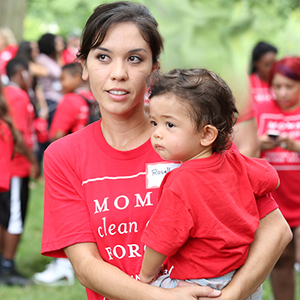


“It’s still common practice for school districts to utilize herbicides like Roundup and Speed Zone, where the active ingredient is the key ingredient in Agent Orange, applied directly to turf. I don’t know when it became normal to use known carcinogens for cosmetic purposes, especially around children,” says Kim Konte, Founder of Non-Toxic Neighborhoods.
Inspired by her sons, Kim has been challenging this norm and campaigning to ban toxic pesticides and herbicides for over a decade, partnering to date with over 200 school districts and universities as well as cities and counties nationwide. “My dad, Bill Henry, used to play for the Yankees. So our two boys had a glove put in their crib. They were all about baseball,” she says.
The typical end-of-summer frenzy to prep kids for the school year ahead is full of emotions and supply gathering. It rarely—if ever—entails plans to safeguard children from the harmful chemical pesticides, herbicides, fertilizers, and fungicides sprayed and applied to sports fields, school grounds, garden beds, fence lines, and playgrounds, not to mention at nearby farms. But that needs to change.
Paying attention to a school’s grounds is now a must. Parents and caregivers can’t just trust that pesticides and herbicides on the market for school use, mostly all petrochemical products derived from fossil fuels, are inherently safe for kids. “EPA doesn’t test the inert ingredients, and they rarely test the active ingredients,” Kim cautions.
Tell Congress: Protect Families From the Plastics and Petrochemical Industry
Why are pesticides so bad for kids?
Children are uniquely vulnerable to harmful chemicals as they’re still developing. Exposures can impact them for a lifetime.
“If you’re spraying to kill a weed, chances are it’s going to have negative impacts on yourself, the workers, and on the pollinators and ecosystem around it. These chemicals are linked to cancer, neurological impacts, and kidney disease,” says Mackenzie Feldman, Founder and Co-director of Re:wild Your Campus, a nonprofit dedicated to helping colleges and universities—including Stanford, Oberlin, Grinnell, Harvard, and the University of Iowa—stop using pesticides and transform into “healthy places.”
Kids are highly exposed to what’s sprayed on school grounds because of how they play. “They interact with their environment more. There’s more hand-to-mouth behavior. They breathe twice as much as we do. So having these chemicals around children is something that we really need parents to connect the dots on,” says Kim.

Parents and students can make a difference
At a volleyball practice at UC Berkeley in 2017, Mackenzie, then a student, and her team were told their training courts had been sprayed with Ranger Pro, a glyphosate-based herbicide. “This was two years after the World Health Organization declared glyphosate a probable carcinogen,” she says.
Alarmed, she and a teammate asked to be put in touch with the school’s Athletic Fields Supervisor. “Can you not spray this where our team is practicing? We’re all young women of reproductive age with skin exposed,” she recalls asking him. The team offered to hand-pull weeds instead. It worked. “I learned an important lesson: Come at a problem with an offer to be part of the solution and not just complain.” Eventually Berkeley even agreed to go herbicide-free campus-wide.
Mackenzie’s lesson is useful for anyone wanting their schools to stop spraying toxic chemicals. For those needing help getting started, Re:wild Your Campus hosts advocacy boot camps—the next is September 2—to help students organize to tackle school pesticide use.
Non-Toxic Neighborhoods also offers tangible help, including a step-by-step playbook for families on implementing safeguards within school districts. It includes tips on having conversations with administration, plus peer-reviewed research to back up concerns as well as details on alternatives to toxic synthetic chemicals with demonstrated proof of efficacy.
While every state is different, Kim says school principals have the authority to stop pesticide application. “Our first step working with a school district is to request a pesticide usage report to understand the pest pressure. You find out what they’re using, and then you create a committee of concerned parents. We recommend having a school nurse and someone from your city involved,” Kim explains.
Groundskeeper training
A principal is rarely the person spraying chemicals. This makes contacting maintenance critical to success. “Almost every school district has a maintenance and operation department. Just reach out to the director and start that dialogue,” says Kim.
Mackenzie also favors a multi-level approach. She credits a grant to train groundskeepers in conjunction with educating student organizers as key to getting Berkeley to fully transition to organic groundskeeping. “Without groundskeeper training on the technical aspects of how to actually do organic land care, these are just policies without implementation,” she says.
To communicate effectively with groundskeepers, especially in places like San Diego, which has over 400 parks, all maintained by staff, Kim became certified in organic land management. “At these meetings, it’s golf course superintendents. They don’t want to hear from a mom what the problem is. So now I’m a turf nerd. I read soil reports,” she says.
It’s hard to fight the pesticide industry
Land management certification only gets Kim so far when fighting the pesticide industry, which has ties to Big Pharma. Bayer, for example, produces both agricultural chemicals and pharmaceuticals. “Pest control companies make preventative applications of insecticides. So there’s no roaches, there’s no ants. It’s just a business model, but it’s a business model that can’t be around children,” says Kim, who calls the pesticide lobby organized and extremely well funded. “They’ve targeted all our pesticide bans and organic policies. There’s a very coordinated attack,” she contends.
Some even push sales of chemicals with cash-back rewards or rebate programs, she says. So far San Mateo County, California, is the only county Kim is aware of with a resolution prohibiting contractors from participating in manufacturer or vendor incentive, rewards, or rebate programs like “pay-to-play” schemes for herbicides and pesticides when managing vegetation on county land. She hopes other counties will follow suit.
Value added
It’s not just humans that can be harmed by synthetic groundskeeping agents. “These chemicals don’t just stay where they’re sprayed; they leach into the soil and the groundwater. We’re still seeing DDT in women’s breast milk even though it was banned many years ago. Linking it to climate change, pesticides kill soil microbes, limiting soil’s ability to sequester carbon,” says Mackenzie.
That’s why this 2026–27 school year is the time to urge schools to follow her lead and stop the use of these chemicals at the source—before industry turns our playgrounds, schools, and parks into pesticide dumping grounds.
Tell Congress: Protect Families From the Plastics and Petrochemical Industry