


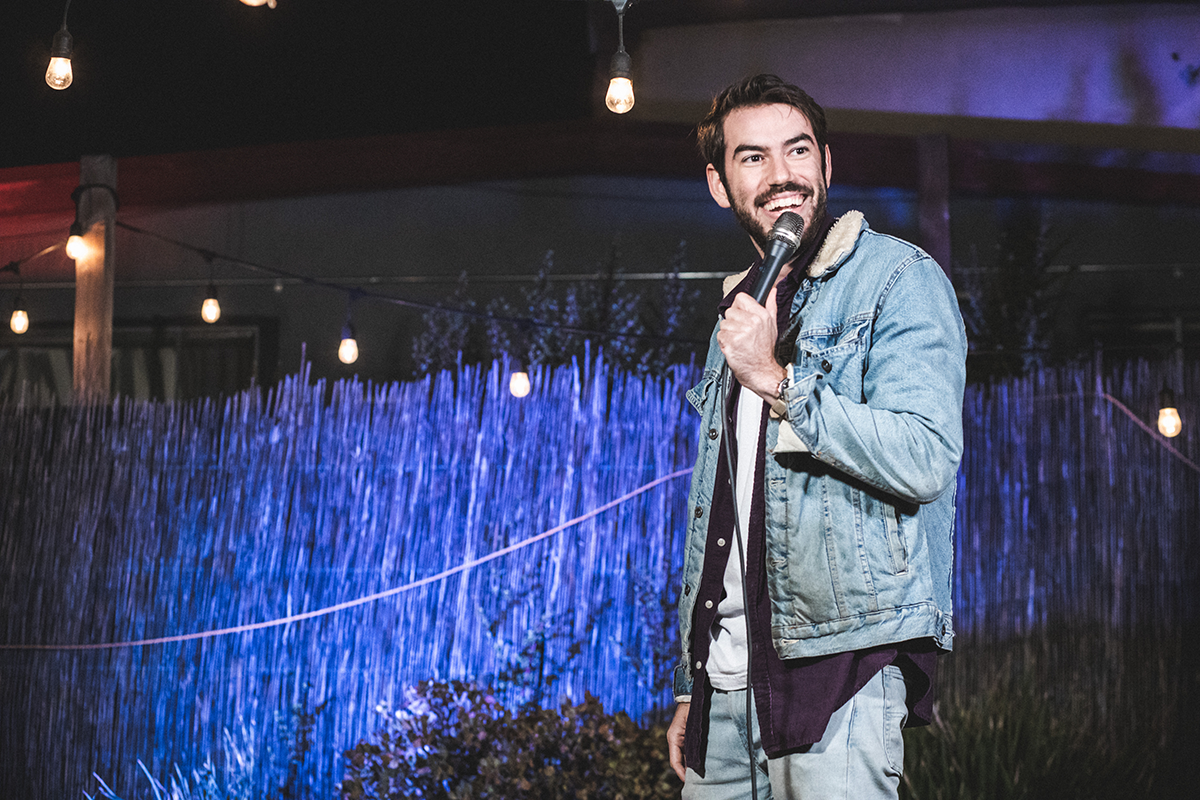
There’s truly nothing funny about the climate crisis. And that’s precisely why Esteban Gast believes comedy is a critical tool in communicating about extreme heat, air pollution, flooding, drought, and so much more. Esteban, a comedian, writer, and host, is comedian-in-residence at Generation180, a national nonprofit working to inspire and equip people to take clean energy action.
Tell the Senate: Sound the Alarm on EPA Administrator Pick
“It’s easy to discount the power of comedy and culture in the climate fight. We’re quick to forget that, for many folks my age, it was a movie, An Inconvenient Truth, that connected us to what was happening. Or that the news was basically shaped by what Jon Stewart was talking about.” Esteban considers John Oliver the greatest inspiration for people to learn more about specific topics right now. “As my friend Ari Afsar says, ‘Art creates culture, and culture creates policy.’ So, artists are incredibly important in movement building,” says Esteban.
While Esteban jokes he found his job “after years of searching for ‘comedian-in-residence’ on LinkedIn,” that’s not at all how he became a climate comic. Read on to find out how Esteban’s work really came about—and what a climate comic even does.
What does your title mean? What does a climate comedian-in-residence at an organization do day-to-day?
After working with Generation180 on some creative funny videos, they invited me to brainstorm what we could do together in a more meaningful and long-term way. I really have to give them credit for that. Rather than saying, “You’re a comedian, and that probably means you are pretty good at marketing or writing, so join our marketing or writing team,” They said, “How would a comedian actually work with our organization and continue being a comedian?” From there, we co-founded the Climate Comedy Cohort, a prestigious fellowship working with professional comedians, with American University’s Center for Media and Social Impact’s Good Laugh program. Generation180 also created Climate Cultura, a monthlong program for Latinx creatives. My work consists of helping run those programs, making silly (and informative) videos, giving notes on silly (and informative) content, and building unique (and informative) ways to flip the script on climate communications.
There’s probably not one specific degree for this job. Can you please share your climate career path?
I was in education for many years. After getting a masters, I was teaching creativity and design thinking at the University of Illinois at Urbana-Champaign, then ran an off-the-grid study abroad program in Panama. But then I moved to Los Angeles and started pursuing my dreams in entertainment. After a few years, I began more deeply investing in entertainment because going after your dreams is really scary. Now, I’m grateful that I get to live the creativity dreams of standup, writing, and hosting and the activism dreams of creating a greener and more just world. And looking back, all the dots are actually pretty neatly connected in terms of education, community-building, and storytelling.
How does your job fight the climate crisis?
I believe we need to invite more people into the climate fight and that the climate movement hasn’t reflected the world around us. Bringing in Latinx creatives, comedians, or folks who are “climate-curious” is wildly important to making positive change. I think of my job almost as a bridge. Generation180 has all these amazing programs from putting solar on schools to community-building to knowledge-sharing about electric vehicles. Our work with creatives is inviting people to learn more about the literally infinite ways to contribute to a healthy planet. As someone who has a job that seems totally unrelated to the climate crisis as a comedian, I really believe that any job can help fight the climate crisis. It’s less about specific job titles and more about the way we’re approaching the work.
In your work, what are your typical battles about climate? What are the roadblocks that seem to come up?
There’s a messaging gap happening right now in terms of clean energy solutions. I just don’t think most folks know that there are so many solutions out there! In a world aching for good news, there’s actual and legitimate good news about the future we are building that’s not being well communicated. And I’m totally and completely biased here, but I believe that a comedian’s ability to synthesize information in the most memorable of ways is exactly the skill set needed to break through the noise.
Speaking of obstacles, funding always seems to be an issue when it comes to grassroots organizing. With our Climate Cultura program, we train and empower Latinx creatives to create art about climate solutions and clean energy. At the end of the program, our creatives make incredible work and we share it. But the success of the program won’t be fully realized for years because at its core it’s about activating influential people in a community. That process is a slow, gradual, person-by-person work of community-building and movement-making. I’ve found that sometimes people want results as quickly as possible so it’s hard to fundraise. “Show us the videos they made from the program!” they say. The real magic is what happens over the course of a few months or a few years, when we’ve equipped people to be champions and ambassadors for the climate fight in their own community.
Who is your career mentor or idol?
There’s so many! Stephen Colbert on The Colbert Report was one of the funniest and most poignant comedians. He made sense of a world and political moment that often felt so ridiculous. I love his comedic approach, which was to respond even more ridiculously. When we talk about what’s happening now, with climate deniers in office and big companies shirking responsibility, I’m inspired specifically by a young Colbert on how to respond artistically to moments that feel absurd-in-a-depressing-way.
The climate crisis doesn’t feel funny. Is it OK to laugh about it?
What we’ve found specifically in the Climate Comedy Cohort is that the climate crisis can be funny in infinite ways. Given information, some knowledge-share, an opportunity to ask questions, and a community to punch up jokes, every single comedian who has gone through the program has created truly inventive and hilarious comedy.
Comedy has always taken on the biggest issues of its time and, at its best, holds a mirror to society. So climate change is funny the way anything can be funny! It’s funny by finding the human emotions of it, the contradictions, the unspoken rules we follow, pointing out the hypocrisies, and all other techniques that people have used throughout the history of comedy. From Dick Gregory to George Carlin, great comedy has come from seriously not-funny topics. It’s our responsibility to make jokes about the climate crisis. Comedy helps us process, understand, and be better equipped to tackle the greatest existential threat to our world. I not only think we can laugh at the climate crisis, I think we must! That doesn’t mean invalidating the seriousness of the problem. Laughing at something also means we’re less scared, and more ready to take action.