



I am old enough to remember the deadly air pollution blanketing towns across the country. Old enough to remember blowing my irritated nose during visits to the city, only to see my handkerchief full of black soot. Old enough to remember people in Pittsburgh using headlights while driving—in the daytime—through thick smog.
I’m also old enough to have spent my teenage years fighting for a better world: for civil rights, for women’s rights, for the right to clean air and clean water. We achieved a great deal. In the face of deadly air pollution smothering cities around the nation, we created a strong Clean Air Act in 1970 and then twice strengthened it. We created the Environmental Protection Agency. With nearly biblical rapidity—given the usual torpor of government timescales—we began cleaning up our air and water.
Now, though, the sound of chainsaws in DC has grown deafening, with EPA Administrator Lee Zeldin contributing his own ear-splitting buzz by attempting to thwart all the progress we made.
Tell Administrator Zeldin: Cutting Climate Pollution Is One of EPA’s Most Important Jobs
Indeed, Zeldin is trumpeting a distorted recalibration of EPA’s mission, moving its focus away from protecting human health to protecting the oil and gas industry. He heralds the “reconsideration” of more than 30 protections from various pollutants, including mercury, which damages the fetal brain, and particulate pollution, or soot, a killer that damages our hearts, lungs, and brains. He is attempting to back EPA out of the job of cutting the climate emissions that endanger us—and the stability of a climate in which civilization has thrived in the blink of a timescale that is recorded human history.
It is worth pausing a moment to review just a handful of EPA’s milestones. A primer, if you will, on why we need a strong, vital, committed agency. In its early days, when it became clear that people were suffering nervous system disorders, kidney disease, and reproductive problems because of lead in the air from gasoline (which also settled in the soil and then in our foods), President Nixon’s EPA moved to start phasing it out. EPA banned DDT and instituted extensive reviews of pesticides; by the mid-70s, the use of two more cancer-causing pesticides, heptachlor and chlordane, was suspended.
EPA stopped chemical dumping into our oceans, set national standards for safer drinking water, began testing for asbestos, phased out the chlorofluorocarbons (CFCs) used in aerosol products, like hairspray, deodorants, and cleaning products, that were depleting Earth’s ozone layer. The Clinton administration accelerated the cleanup of Superfund toxic waste sites.
Republican President Reagan’s EPA launched the Energy Star program, adopted around the world, making appliances more energy efficient. It banned the dumping of sewage into the oceans. President George H. W. Bush tackled the acid rain that was killing acres of trees. In the face of stunning scientific data connecting greenhouse gas emissions to dangerous warming trends across the globe, the Supreme Court ruled that greenhouse gases are air pollutants, and the EPA created the landmark Endangerment Finding and got to work cutting those emissions. In 2007, 30 EPA employees were awarded a Nobel Prize for their climate change research.
These EPA milestones happened during both Republican and Democratic administrations. Today, though, comes the advent of a Republican-led movement toward a chaotic kind of deregulation, and not because that is better for people, or better for the economy—there are decades of data proving that air pollution protections not only help our health, but our economy thrives too.
Zeldin’s destructive approach creates essentially a huge new tax on Americans. It is going to cost us a fortune in skyrocketing health care and insurance payments—to say nothing of increasing the number of heart attacks, cancers, diseases of our lungs and brains and hormone systems, premature births, and premature deaths.
Sure, his actions will be litigated. Scientific and public health and economic data will be reviewed yet again. Years will pass. Millions of dollars will slosh around. And we will lose precious time during which we could be making life better.
Until then, I wonder what the world will look like when my nine-year-old grandson is the age I am now. On the climate front, the 2086 indicators for temperatures, sea-level rise, and extreme weather events are depressing. So these days I’m avoiding that rabbit hole; we cannot know the future. We can’t know what sublime advances in engineering and technology will change the world. All we know is that as capable as some people are of unleashing cruelty and hatred and destructiveness, others are capable of acts of dazzling beauty, profound empathy, bottomless imagination, and enormous love.
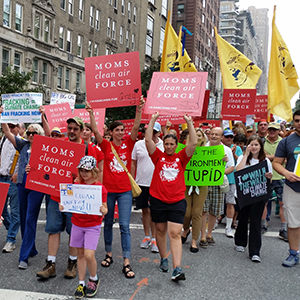
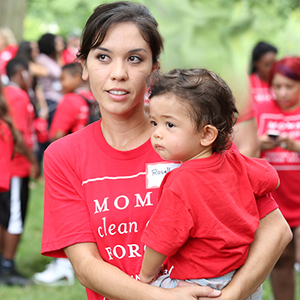
And no matter what happens, we Moms remain united in our work, joined and supported by caregivers across the nation, to clean up air and climate pollution and to protect our children from toxic chemicals.
My hope for Earth Day? Those chainsaws get turned off so we can hear the voices of our better angels.
Tell Administrator Zeldin: Cutting Climate Pollution Is One of EPA’s Most Important Jobs