

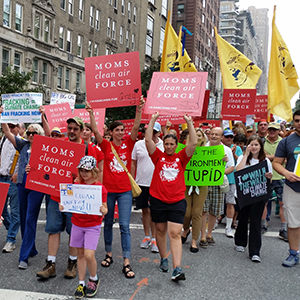



Scrolling through social media lately has been, well, scary. Every other post seems to declare that hard-won climate progress over the past four years will be rolled back under President-elect Trump’s second term—maybe instantly! After all, a lot of anti-environmental promises were made while campaigning. The result is chaotic, especially as there is so much unknown. In Moms’ meetings, we started talking about whether these black-and-white claims could actually all be factually accurate—or even possible. Then we started fact checking. You know what happens when chaos meets truth?
Anxiety fades.
The result is our new series #MomsFactCheck. It’s intended to lower anxiety by cutting through the noise to uncover the truth behind the wide-ranging declarations flooding—and clogging—our feeds. We aren’t sugarcoating how bad things may get. We are clear-eyed. But also it turns out that nothing is certain for sure and most of us—no matter how we voted in the recent election—care deeply about protecting our planet. Here’s our measured take on six anti-climate statements we’ve recently heard and researched. For more #MomsFactCheck on alarming climate headlines as we head into 2025, follow us on Instagram, Facebook, X, or Threads.
Tell the Senate: Sound the Alarm on EPA Administrator Pick
1. U.S. voters overwhelmingly care about the environment
The U.S. feels impossibly divided right now. But according to 2024 voter priority polls conducted by Environmental Protection Network, the majority of us, no matter who we voted for, want to protect our shared planet:
- 76% of Trump voters and 86% of all voters oppose attempts to weaken EPA.
- 81% of Trump voters and 88% of all voters want Congress to increase EPA funding or keep funding steady.
- 72% of Trump voters and 80% of all voters support increasing federal funding to communities disproportionately harmed by air and water pollution.
Source: Environmental Protection Network
2. EVs may still be affordable in 2025
It’s highly likely EV tax credits as we know them will cease to exist when President Trump takes office. He did promise to end President Biden’s “EV mandate” while campaigning after all. It’s a tremendous loss for the clean transportation transition. But opportunities are already popping up that show people are committed to keeping EVs affordable. The governor of California, the country’s leader in clean vehicles, has announced plans to restart a state rebate if the federal tax credit is eliminated. Hopefully, others will follow suit.
And never rule out an about-face. Having Tesla CEO Elon Musk as a close confidant could change course. As Trump said in August, “I’m for electric cars. I have to be, because Elon endorsed me very strongly.”
Sources: The Hill, Fast Company, California.gov
3. The Inflation Reduction Act is too big to repeal entirely
It’s been over two years since Congress passed the IRA, the largest investment in combating climate change. Many major new clean energy and clean vehicle projects are already underway. The amount of green jobs created as a result is substantial. Advances in both tech and finances have resulted in solar costs dropping by more than half since 2016! The cat’s already out of the bag.
The IRA can be slowed and tax credits could be slashed, but it’s too big to repeal entirely. And while no Republicans voted for the IRA, the majority of this federal money for clean energy is flowing into Republican districts, so there would likely be bipartisan opposition to a total repeal. Climate progress is in danger, yes, but a total IRA wipeout is unlikely.
Source: Yale360
4. EPA won’t just cease to exist
“You can’t eliminate the agency. But you can starve and cripple it,” Michael Gerrard, Director of the Sabin Center for Climate Change at Columbia Law School, told Inside Climate News.
To eliminate EPA would require a majority of the House, 60 votes in the Senate, and overcoming serious opposition from environmental and public health advocates, notes Jody Freeman, Founding Director of Harvard Law Environmental Law and Policy Program. While that’s very unlikely, it’s still not going to be pretty.
Source: Inside Climate News
5. “Drill baby drill” is bad for business and the economy
Media outlets have been trying to figure out how more drilling would help anyone on either side of the political spectrum—and who even wants it. Turns out … maybe no one?
U.S. oil and gas production is currently setting records, and more production could hurt oil companies’ bottom line. Experts agree more drilling won’t happen now—and without a national emergency, the federal government can’t force companies to boost drilling.
Source: Politico’s E&E News
6. Environmental justice isn’t dead, though it’s at risk
The Biden administration set a goal that 40% of climate, clean energy, affordable and sustainable housing, and other investments would flow specifically to communities marginalized by underinvestment and overburdened by pollution. This is its Justice40 Initiative—and it’s at risk under a new administration that is not expected to similarly prioritize environmental justice.
Still, Justice40 applies to more than 500 programs across 19 federal agencies. That’s not a simple thing to dismantle in one fell swoop. According to Myron Ebell, who led the EPA transition during Trump’s first term, “It’ll be a hard slog for the Trump administration, but I’m sure it’s going to be on their list of things to get rid of.”
Sources: MSN, WhiteHouse.gov