




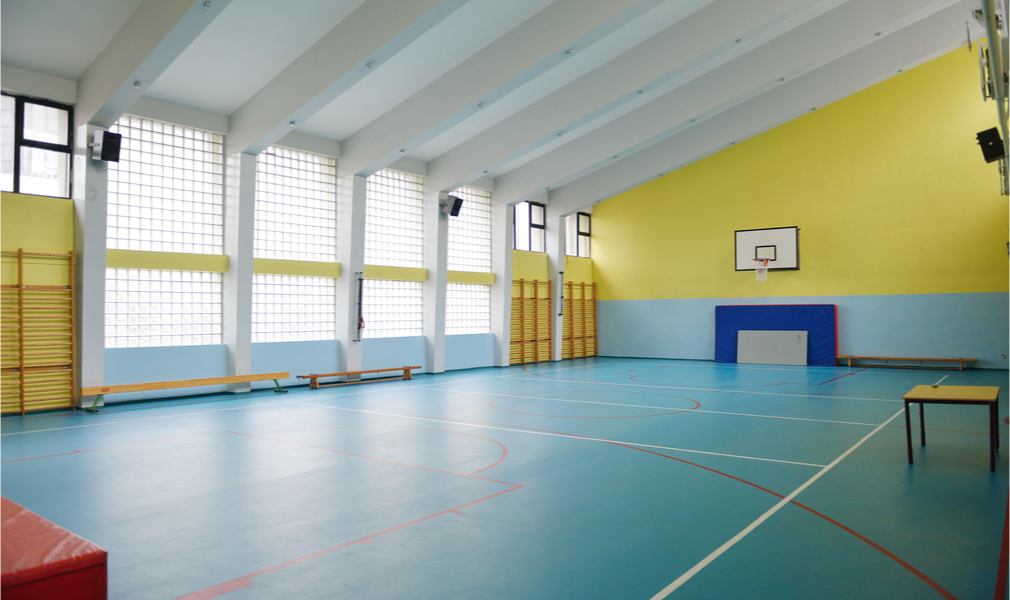
When I heard about the issue of mercury vapors from school gym and all-purpose room floors, my first thought was: is that happening in my children’s school?
To catch readers up, rubber-like polyurethane floors, which contain phenylmercuric acetate (PMA) as a catalyst, have been installed in schools, gyms, cafeterias, stages, and indoor and outdoor tracks since the 1960s. PMA is a probable carcinogen, and also releases mercury vapors as it breaks down. Mercury is a potent neurotoxin that is particularly harmful to pregnant women and children, and can lead to neurological, developmental, and behavioral disorders.
This is something to take seriously. And it led me to more questions: How do I find out if this is happening in my children’s school? What do I do about it? And most importantly: How do I keep my children safe?
This can be overwhelming, but there are ways that parents can take control in this situation to either rule this problem out for your school or take action to protect your children. Let’s go through things one by one to make it approachable.
Determine if your kids’ school has a gym floor that is made of the particular type of rubber at issue. If the gym floor is made from wood or tile or another hard surface, it can be ruled out. If, on the other hand, it’s a softer material that’s rubber-like, the floor could be made from synthetic polyurethane. Not all synthetic polyurethane floors contain the PMA that releases mercury vapors, but some do. Learn more here.
If the floor appears to be rubber-like, either write a letter or call the principal to ask for it to be tested. Ask for specific testing:
- Bulk samples of suspect flooring for phenylmercuric acid (PMA)
- If bulk samples are above 1 ppm, a representative number of full-day, breathing zone air samples should be collected in the room for analysis for mercury by an accredited laboratory.
Be prepared for pushback; the New Jersey Education Association notes that school boards and districts “may hesitate to identify mercury-containing floors because they perceive them as a problem that could be quite costly to address and upsetting to the public.”
Hold a parent meeting, either informally or through a PTA/PTSA to educate others and get them involved to solve the problem. Having support, or even an organized committee, will help immensely in making this problem feel less overwhelming. It will also make it harder for hesitant school officials to ignore the issue.
It may also be helpful to connect with other schools dealing with this. It’s still a new problem and each school can learn from what others do/don’t do. Other schools confronting mercury in flooring include New Jersey’s Wenonah Elementary, and Long Island’s Amityville, Merrick, and Miller Place schools.
Insist that the school close the room until and while test results are conducted.
If test results are concerning, insist that the school a) keep the room closed to students and b) remove the harmful flooring. Covering or sealing existing problematic flooring may not be effective, and will only be added cost. It must be removed completely.
Learn more at the New Jersey Education Association, which has an in-depth guide and several resources for how handle this issue.