



This article is part of our occasional series Life Under Threat, where we share the stories of families whose health has been put at risk by polluting industry, from “advanced recycling” plastics incinerators to AI data centers to oil and gas operations.
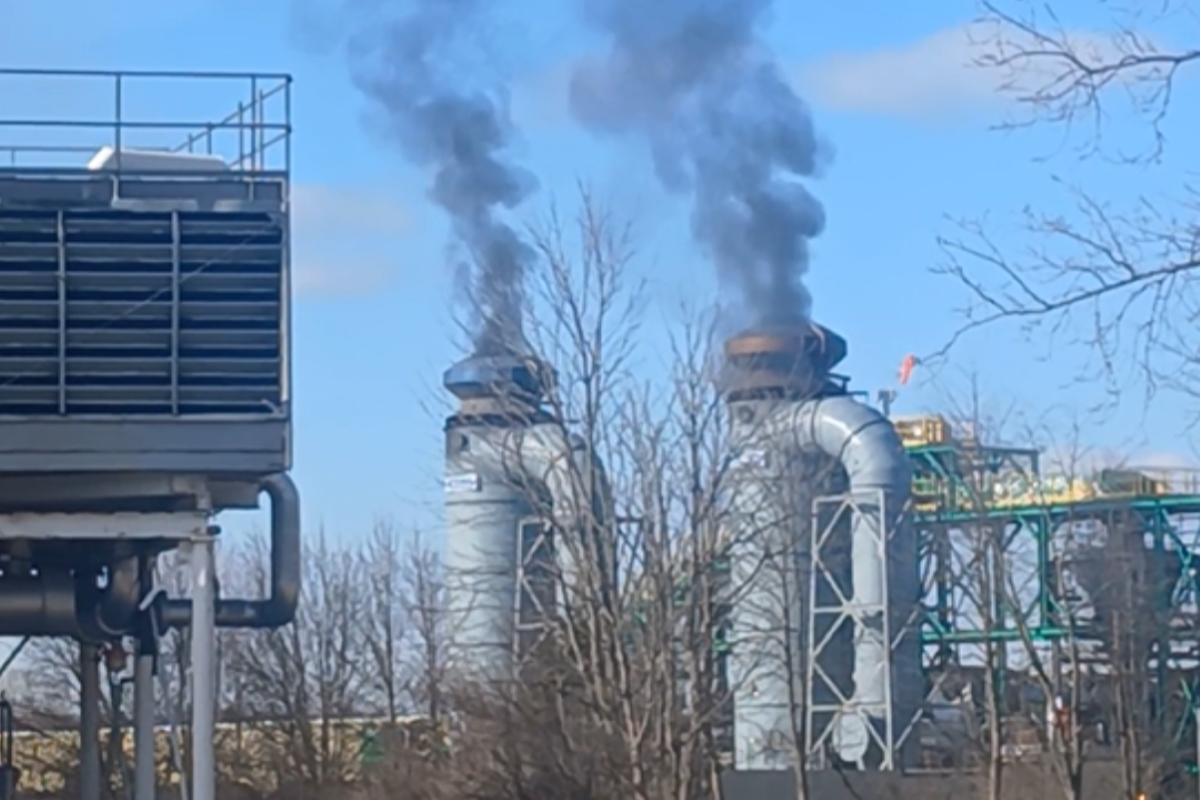
Last year, Moms’ organizer Amanda Rowoldt took a video of a brand new “advanced recycling” plastics burning facility in Hebron, Ohio, emitting toxic black smoke into surrounding neighborhoods. The video of the Freepoint Eco-Systems facility captured the attention of the press, local lawmakers, and the Ohio Environmental Protection Agency. After nearly 18 months, Amanda’s persistent advocacy alongside a local coalition to stop the plant from polluting has paid off. On May 28, Freepoint suspended its operations in Ohio! This is the story of this major victory for clean air.
Tell Congress: Burning Plastic Is Not a Solution to the Plastics Crisis
As told to Julie Kimmel by Amanda Rowoldt:
Since the Freepoint “advanced recycling” plastics incinerator in Hebron, Ohio, began operations in late 2024, it has been problematic. It received three air permit violation notices in 2025 for soot emissions over the permitted limit, failure to report malfunctions, noncompliance with air pollution controls, and other infractions.
The Ohio EPA said in February 2026 that they were working with Freepoint to get them in compliance following the 2025 air permit violations. I kept checking in to see how this was going, but at some point, I was no longer getting responses.
The ultimate permit violation
Then, on April 28, 2026, the game really changed. Freepoint received another violation notice, this time saying the facility did not qualify as a recycling unit and could no longer be exempt from Clean Air Act protections. For nine consecutive months, Freepoint had been claiming what’s called the “plastic/rubber recycling exemption,” an obscure loophole that allowed them to bypass the pollution control, monitoring, and reporting requirements for solid waste incinerators. They said the exemption was owed because they could convert more than 70% of the plastic waste at the facility into feedstocks for chemical plants and petroleum refineries.
Freepoint did not want to be classified as an incinerator because it would have to install pollution controls for its extremely dangerous emissions. Plastics, made by combining fossil fuels with mixtures of 16,000 synthetic chemicals, are extremely toxic. Burning plastic in incinerators like Freepoint’s releases potent carcinogens and other toxic air pollutants, including soot, nitrogen oxides, lead, cadmium, mercury, and dioxins. Exposure to this pollution has serious health impacts, including increased risk of cancer, reproductive system damage, cardiovascular problems, hormonal irregularities, and neurological problems.
Ultimately, Freepoint admitted to the Ohio EPA that it could not meet the 70% rate required by the regulatory loophole. In truth, they were really shooting for the stars in suggesting they would be able to. When they received the April violation on top of all their violations last year, it was clear they had gotten in over their head. And the pressure from the community was strong.
The final days
I reached out to state officials on May 28, saying local families deserved some answers. And I got a response! On May 29, I learned that Freepoint had suspended its operations the previous day. It turns out that after the notice of violation was issued on April 28, Freepoint had been given 30 days to come up with a plan to get in compliance with its permit. At that 30-day mark, they suspended operations, citing “market conditions.”
What happens now
Freepoint is now required by the Ohio EPA to do a few things, including securing all the equipment and dealing with the toxic waste. That makes this closure seem indefinite to me. When Freepoint closed temporarily last year after one of its first violation notices, they continued to use their equipment and test things out; they never shut everything down. Still, much of the secured equipment will stay in Hebron, meaning Freepoint or a new owner could start up the operation again. Ohio Moms are remaining vigilant.
“Advanced recycling” is not possible
The Ohio facility is not Freepoint’s only “advanced recycling” incinerator. They also have a facility planned for Eloy, Arizona. This closure in Hebron raises questions for that proposed facility. This win also says something larger about the plastics waste industry. It chips away at the narrative that this technology is viable or worthwhile.
We haven’t seen other state agencies hold existing facilities to the Clean Air Act’s 70% threshold. This sets a precedent for state regulators to stand up to similar misinformation from other “advanced recycling” facilities that are claiming the same regulatory loophole.
Here in Ohio, we’re definitely going to press the state EPA for access to information about how much plastic waste Freepoint was actually able to convert into industrial feedstock. We also plan to look at the Alterra Plastic Recycling Facility in Akron. We need to find out what recycling threshold they claim to be meeting. We have long held that Akron’s eligibility for the 70% plastics recycling exemption is suspicious and deserves a closer look.
Celebrating the win
When I took the video of the toxic black smoke coming out of Freepoint’s stacks last winter, I couldn’t have guessed that 18 months later the facility would suspend its operations. I do think my video got the ball rolling. It was the start of something that Moms, Buckeye Environmental Network, and other groups, community members, and government officials ultimately all contributed to. It was evidence of an air permit violation that the Ohio EPA couldn’t ignore.
In the end, I think we saved lives. I was only at Freepoint for a few minutes in February 2025, and I can still viscerally recall the physical symptoms I experienced—dizziness, headache, nausea. I can’t imagine what it would be like to breathe in that pollution day in and day out. There are schools, parks, and playgrounds one to two miles away. I’m grateful that this place has shut down. Moms and all the groups coming together—we really did something good here.
Tell Congress: Burning Plastic Is Not a Solution to the Plastics Crisis