



This story is part of our series Science Matters, where we interview scientists about the practical implications of federal attacks on science jobs, funding, and education for everyday families and public health.
After the first Trump administration, Dr. Phil Landrigan and a group of scientists evaluated the impacts of a broad array of the President’s actions, including rollbacks from Obamacare to the environment. “Air pollution in this country, specifically PM 2.5 emissions, had come down by 77% since Richard Nixon signed the Clean Air Act, an enormous triumph for public health,” says Dr. Landrigan, a pediatrician and public health physician.
For the first time in decades, these levels bounced up during Trump One, a discovery published in the group’s report in The Lancet. “The aggregate is a minimum of 20,000 unnecessary deaths in America concentrated in a line of states running south from Ohio. The heaviest burden was very clearly in red states that tend to have more industry and generally speaking much weaker environmental and public health safeguards,” he explains.
Tell Congress: Defend EPA’s Ability to Protect Human Health and the Environment
Now, as the Trump administration has launched what amounts to an open war on science, cutting jobs, slashing funding, undermining education, and changing what constitutes scientific fact, especially regarding global warming and public health, Dr. Landrigan says, “We can only speculate Trump Two will be worse because they are moving more swiftly and they are better organized.”
What’s going on?
Reading the news daily, it’s difficult to understand what this means for scientists. Anti-science news dominates headlines: More than 400 active research awards have been cut from the National Science Foundation! Research budgets are frozen or halved! University studies on AIDS and pediatric cancer are defunded! Science is elite!
Alan Burdick sums up the current state of affairs in the New York Times: “The Trump administration has targeted the American scientific enterprise, an engine of research and innovation that has thrummed for decades… The chaos is confusing: Isn’t science a force for good? Hasn’t it contained disease? Won’t it help us in the competition with China?”
Dr. Landrigan, perhaps best known for his tireless work to get lead out of gasoline in the 1970s, says, “I think broadly speaking Trump is trying to hollow out the agencies that collect data on the state of America’s health. And he’s doing that in several ways: by terminating a large portion of the workforce in each of those agencies across the board and by rolling back regulations by executive order and failing to enforce regulations that are not rolled back.”
No government agency is being left untouched, from EPA to the Department of Health and Human Services (HHS) to those responsible for weather and climate data, the National Oceanic and Atmospheric Administration and NASA.
Data is also being taken down or not released. Dr. Landrigan notes that the Centers for Disease Control and Prevention (CDC) have been slow to publish data on rates of disease. “Stuff as fundamental as measles case counts, which have been reported weekly without fail since the 1950s. He’s undoing 70 to 75 years of work by simply failing to report data.” In some instances, he does this by putting workers on leave, like the 17-person team at HHS in charge of the National Survey on Drug Use and Health. They’ve been tracking trends for 50 years. “We no longer know if it’s going up or down or where it’s occurring or who is most at risk,” says Dr. Landrigan.
Similarly, the group that oversees the Pregnancy Risk Assessment Monitoring System, an important tool for trying to reduce maternal mortality, is being undermined. The list goes on.
Why would anyone want to undermine science?
The administration has offered various explanations for their crackdowns: cost-cutting, efficiency, and notes Burdick in the New York Times, “defending women from gender ideology extremism.” Still, industry appears to be the clearest answer.
“[EPA Administrator] Lee Zeldin, when he announced the rollback of all sorts of air pollution protections, said he was ‘freeing American industry from the shackles of regulation.’ That’s the gist. They are basically pandering to big business and specifically to polluting industry, not worrying about safeguards that have been protecting public health in the U.S. for the past 75 years,” says Dr. Landrigan.
What will happen to science in the U.S.?
Beyond the scientists directly employed by the federal government, scientific research at labs, universities, and institutes in the U.S. has long been supported by federal funding. This system has allowed America to be known globally as a leader in scientific breakthroughs. Even as this federal support is being rescinded, not all is lost. Some scientists can turn to private money, and there are indications businesses may step in with inventive ways to fill voids. Dr. Landrigan’s work today is supported by foundations, not the federal government.
“I’m in a very good university and not directly in the crosshairs,” he says. He holds various roles at Boston College, including Director of the Program for Global Public Health and the Common Good as well as Director of the Global Observatory on Planetary Health. “I think you are going to see efforts made in the private sector to collect and disseminate data,” he says. Of course, this will work better for, say, air quality with at-home monitors and less well with the sort of data NOAA and NASA collect mostly via satellite.
Unwilling agencies
What can and will likely hinder science is unwilling agencies. Dr. Landrigan isn’t sure he’d be able to get lead out of gasoline today. “It’s hard to say. I did my initial work on the toxicity of low-level lead as a young doctor employed by the CDC. My friend Herb Needleman did parallel studies at Boston Children’s supported by NIH [National Institutes of Health] grants. Both probably would not have been permitted had Trump been in power,” he says. For anyone who has fought for or even followed environmental health legislation in the U.S., this is painful to hear.
Today, Dr. Landrigan isn’t sure EPA would even allow him to present. In the 1970s, when he did present, “EPA did the right thing. I cannot imagine the current EPA would do that.” Back then, the lead industry fought back hard but failed. And the process unfolded under several presidents: Nixon, Ford, and Carter. “In those days, both parties more or less supported environmental issues especially when they had a health dimension. Not all was rosy, but there was much more consensus than there is today.”
What people can do to support science
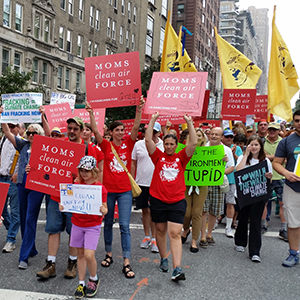
We can all push back to support scientists. “Doctors don’t march in the streets, that’s not what we do,” says Dr. Landrigan, noting that the American Academy of Pediatrics is pushing back as an organization, publishing fact checks of misinformation and issuing statements opposing funding and staffing cuts to health agencies.
But the rest of us can march in the streets. “People are starting to get mad, and you can hear the rumblings, which were quiet at first. There have been events that have really pissed people off, and a constituency that supported Trump is beginning to have second thoughts,” he says.
We can also call out hypocrisy. “They’re now having breakfasts where they open the meeting with a prayer and then make decisions that result in the death of poor children. People who say they believe in the right to life are poisoning children with mercury, damaging the brains of infants in the womb, and increasing levels of particulate air pollution inhaled by pregnant women. It simply doesn’t parse. Americans don’t like hypocrisy.”
Tell Congress: Defend EPA’s Ability to Protect Human Health and the Environment