




The Trump-AI-fossil-fuel industrial complex is aimed at one thing: unrestricted data center growth, no matter the cost. This growth is already coming at the expense of our clean air, clean water, livable climate, affordable energy, and job security. Now we can add another dangerous consequence to the list: a new generation of forever chemicals unleashed on the public.
Following a July 2025 Executive Order, “Accelerating Federal Permitting of Data Center Infrastructure,” EPA Administrator Lee Zeldin announced in September, “EPA will prioritize the review of submissions for new chemicals that are intended for use in data center projects or in the manufacturing” of related components.
Unfortunately, data centers use an increasing amount of PFAS (per- and poly-fluoroalkyl substances)—a class of chemicals used to make coatings that resist heat, oil, and water. They are called “forever chemicals” because they don’t break down in the environment. So that means they persist in soils, contaminate water sources and food, and can remain in our bodies for a very long time. Studies have linked them to various health threats, including cancer, liver damage, and immune system harm—and especially vulnerable are babies and children.
Tell Congress: Protect Families From Dangerous Data Center Air Pollution
Two of the best-known forever chemicals, PFOA and PFOS, are banned in manufacturing, but thousands of others are not.
Data centers primarily use PFAS in their computer servers’ semiconductors and in some of the latest cooling systems for large AI data centers. The life cycle of advanced servers may only be three or four years, but EPA and states like Virginia “don’t have strict regulations on how to dispose of the parts with forever chemicals,” as the Chesapeake Bay Journal noted in December.
Some AI data centers are also starting to use PFAS gas, or f-gas, as a coolant since the chips their servers use are running hotter and hotter. [Editor’s note: In fact, the petrochemical giant Chemours is using the f-gas needs of data centers as an excuse to expand PFAS production at its West Virginia and North Carolina facilities.]
The AI industry says f-gas is not dangerous because, in the air, it turns into trifluoracetic acid (TFA), which the U.S. does not consider a PFAS. But a great many other countries do. Indeed, recent research finds that f-gases are more toxic than had been realized, and increasing concentrations have been found in “rain, soils, human serum, plants, plant-based foods, and drinking water.” Some are also 10,000 times better at trapping heat than carbon dioxide.
The data center surge also drives toxic chemical pollution indirectly because the semiconductor industry is a large source of unmonitored and unregulated PFAS. Testing data from one U.S. fabrication production plant found PFAS levels in wastewater 20,000 times higher than the EPA legal limit for several common compounds. The Guardian reported in 2024 that producers of PFAS and semiconductors have “formed a group that develops industry-friendly science aimed at heading off regulation as facilities release high levels of toxic waste.”
In July 2025, Zeldin wrote an op-ed for Fox News: “Trump’s EPA clearing the regulatory path for America to dominate the global AI revolution.” He asserted—without providing any evidence—that Biden administration policies “have been criticized by many as making EPA a brick wall that impedes the growth of the AI industry.” Yet the AI data center industry grew exponentially under Biden.
But for Zeldin, the race to beat other countries has become an excuse for embracing the most backward view of regulations. He wrote, “A company looking to build an industrial facility or a power plant should be able to build what it can before obtaining an emissions permit.” But that turns EPA into a rubber stamp for whatever industry wants to do.
“I think they want to impose as few restrictions as possible on chemicals,” Greg Schweer, former EPA chief of new chemicals management, told Wired in November. “In previous administrations, political people stayed out of [chemical regulation]—they tried to let science win. Here, the industry has a willing set of ears that wants to listen to their opinions.”
In September, EPA issued instructions for industries with new toxic chemicals to request priority review for chemicals used for “qualifying data center projects.” Qualifying projects include data centers that cost more than $500 million or require a new electricity load more than 100 MW. They also include any “data center project or covered component project” that either “protects national security” or “that has otherwise been designated by the Secretary of Defense, the Secretary of the Interior, the Secretary of Commerce, or the Secretary of Energy as a ‘qualifying project.’”
Clearly, those instructions cover almost everything for an administration that has justified almost everything they do by asserting it protects national security. “There are some really big loopholes in here to get chemicals through,” Schweer told Wired. All you need is “some friend at the Department of Defense or the Department of Commerce,” who will send a letter stating, “This is a qualifying project.” Then “there’s no proof involved.”
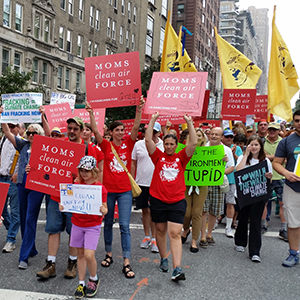
Until we get genuine EPA oversight by Congress, the best way to protect your family from all the consequences of data centers is to join Moms in calling for strong protections from data center pollution, including chemical monitoring and public disclosure of PFAS use, releases, and disposal and plans to transition to proven safer PFAS alternatives. Earlier this year, Moms helped center air pollution and health impacts in a Wisconsin farming community’s successful campaign to stop a proposed AI data center. “Because it’s not a one-person fight; it’s a community fight,” says Moms’ Wisconsin organizer Jayne Black. “And every voice matters.”
Joseph Romm is a former Acting Assistant Secretary of Energy and Senior Research Fellow at the University of Pennsylvania Center for Science, Sustainability & the Media.
Tell Congress: Protect Families From Dangerous Data Center Air Pollution