



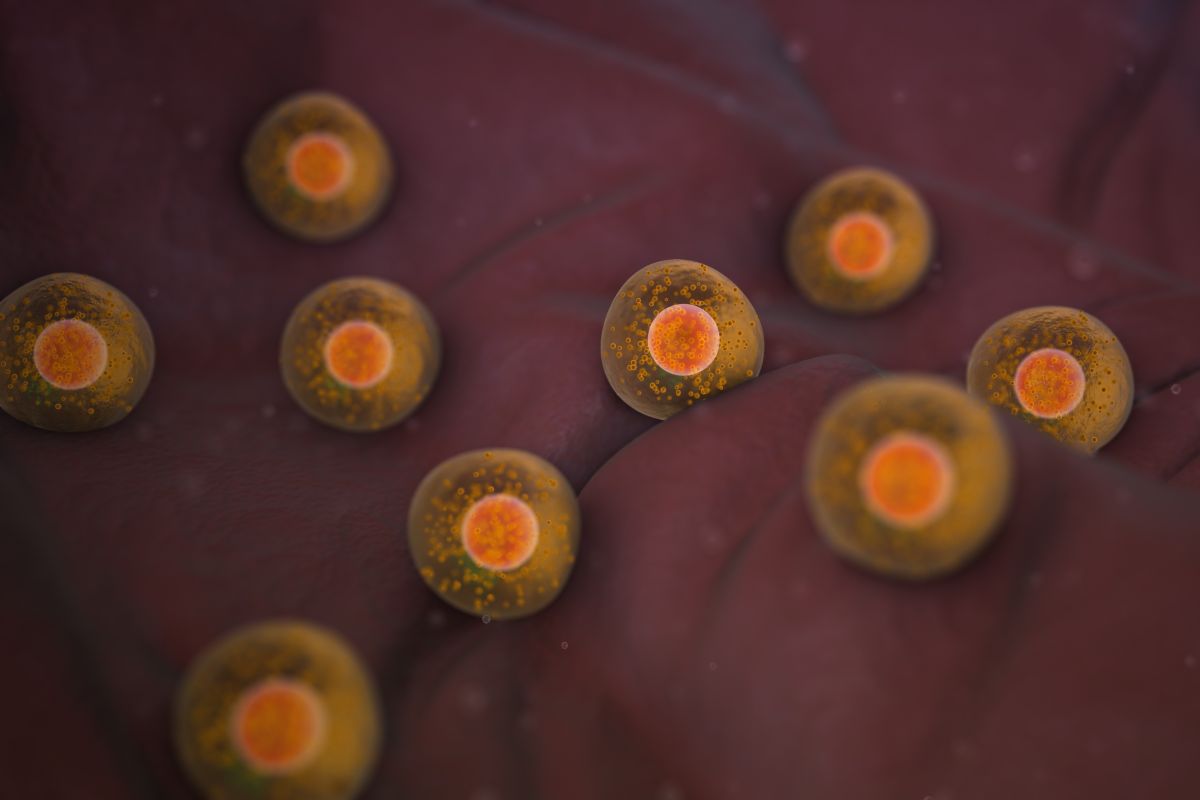
Want to know how a wide variety of toxic chemicals found in everyday products impact sperm—from motility to count? You’re in luck. Studies have been done. Entire documentaries have been devoted to the topic. Want to know the same about eggs? It’s going to take some sleuthing—and time.
“There should be more people studying that question. We have a better understanding of the male situation versus the female,” says Patrick Allard, PhD, Assistant Professor in the Institute for Society and Genetics at UCLA.
Accessibility plays a role in this imbalance. It’s easy to get sperm to study, and they constantly regenerate. Eggs are less accessible, and women are born with all they’re ever going to have; new eggs can’t be made after birth. “That means there’s a lot of really intricate and specific things that happen in females that can only be observed if you have access to fetal tissue. And of course, there are big ethical issues there,” says Dr. Allard, whose research at the Laboratory of Environmental Memory focuses on the effect of environmental exposures on reproduction.
While fetal tissue has been studied in this realm, researchers mostly resort to using yeast, a tiny worm called C. elegans, or mice, which Dr. Allard says raises other questions. “Very often access to good, reliable information, it’s just in men,” he says.
Dr. Tracy Woodruff, Professor of Epidemiology and Population Health at Stanford, adds, “It’s just a lot easier or there’s probably some male influence in this whole thing that I don’t know about.”
Still, there’s reason to be concerned about how exposures to toxic pollutants affect egg quality. “Eggs—that’s the layperson term—but fetal eggs, female eggs, or even the parts of male eggs that are going to become sperm could be compromised by exposure to toxic chemicals in utero. We have data showing that pregnant women are exposed to many toxic chemicals,” says Dr. Woodruff, a Senior Fellow at the Woods Institute for the Environment who spent over a decade at EPA. She mentions a recent study from one of her collaborators showing that amniotic fluid has many chemicals in it. “And her research shows that many of these chemicals can adversely influence the process of making the eggs.”
Tell Congress: Protect Our Families From Harmful Toxic Chemicals
What chemicals can harm eggs?
Researchers studying which chemicals are harming eggs—and how—are mostly focused on chemicals found in everyday stuff, nothing rare or unusual. This includes chemicals that make shampoo and cleaning products foam, those added to plastics to make them flexible, and pesticides. Some of these have been widely studied for impacts on human health, like the hormone-disrupting chemical bisphenol-A (BPA), used to make plastic hard, to line food and beverage cans, and to coat thermal receipt paper. “Other toxic chemicals can adversely impact the quality of eggs too, then leading to inability basically to get pregnant. Not enough people know about this work,” says Dr. Woodruff, who also leads the Health and Toxics Policy Lab at Stanford.
There have been studies on the negative impacts of microplastics, persistent organic pollutants, and endocrine disruptors on eggs, but to truly map the chemical space and understand more broadly how it interferes with female reproduction, researching one chemical at a time isn’t efficient.
Dr. Allard says the “giant elephant in the room” is that so far no researcher has a good handle on exposure to mixtures of chemicals. “We are several decades behind generating enough data to understand what endocrine disruptor A plus B do together. Do they cancel each other? Do they magnify each other? It’s a mathematical problem, the number of possibilities of combinations that need to be tested. That’s near impossible to do. But we have to start somewhere.”
What women can do
As researchers get up to speed, and in the absence of strong chemical regulation, women wanting to safeguard their eggs can start by reducing exposure to chemicals known to cause harm. “Rarely do people have one type of behavior or exposure that’s the issue. Most of the time it’s this accumulation of different things in the environment that we’re exposed to,” says Dr. Allard. He suggests addressing “body burden” by reducing the soup of toxic chemicals we are exposed to daily (find tips for doing this here). This can also help increase sperm count. Still, “detoxing” and lowering body burden can’t change that, when it comes to eggs, there are biological processes already completed long ago.
“We unfortunately can’t fix the damage that was done. We can stop the damage from happening to future people. In the case of the quality of your eggs, it can be influenced by exposure to toxic chemicals, but every egg may not be compromised. It may be 2% or 3%. We just don’t know because the research is not very good on this. It could be that you can increase your chance of a successful pregnancy by reducing some of your exposures to toxic chemicals. And eventually the higher quality eggs will be successful,” says Dr. Woodruff.
Beyond reducing exposure to chemicals in plastics, Dr. Allard is specifically concerned about limiting contact when possible with PFAS chemicals. The “best validated” of their reproductive defects is small gestational weight, he says. He’s also concerned about quaternary ammonium compounds, a.k.a. quats, frequently found in cleaning products, which Dr. Woodruff put on his radar. She asked some colleagues, including Dr. Allard, working in laboratory models of reproduction, to blind-screen specific chemicals that pregnant people in California are exposed to. Quat exposure led to chromosomal errors in the lab, which are usually just the tip of the iceberg. “That tells us that there’s a lot more going on early,” says Dr. Allard, who is now researching earlier during reproduction to figure out the pathways that go awry.
Beyond fertility
Lowering body burden is always good common sense, even for women past their reproductive years. “If you have toxic chemicals impacting your ovaries, it affects your ability to successfully have a healthy baby. And also later in life, it can impact healthy aging and could influence menopause,” says Dr. Woodruff, who is frustrated we don’t know more about the connection between toxic chemical exposure and menopause. “We could know more if there was more research devoted to it,” she adds.
Here, yet again, there’s a male-female divide. Female reproduction ends “rather abruptly” in women, notes Dr. Allard. Men, not so much. He’s also researching overall aging, including reproductive aging, and quat exposure. “The big problem is that earlier onset of menopause could be caused by an exposure that happened way back when. In humans, how are you ever going to prove that kind of thing? Without human data, it’s a very, very difficult thing to establish.”
At least there are people trying.
Tell Congress: Protect Our Families From Harmful Toxic Chemicals