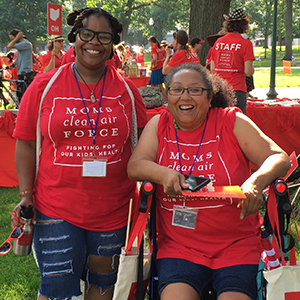

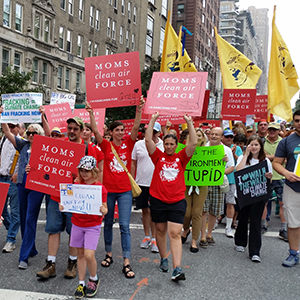


If a new polluting facility is moving into your neighborhood, you’d want to know about it, right? Moms would. That’s why 13 of our staff and members gave testimony at a recent EPA hearing about a new rule that could allow polluters to get permits for new so-called “minor” pollution sources without even notifying local communities. This proposed rule would take away one of the only opportunities communities have to learn about new pollution sources before they are built and ask important questions about how those facilities will affect the air our families breathe.
What’s more, “minor” sources of pollution are not harmless. They can include AI data centers, chemical manufacturing facilities, and other industrial complexes—all of which can create significant emissions, especially when multiple projects are concentrated in the same neighborhood or facilities expand over time. They can do this through piecemeal permitting, where larger projects are broken into smaller units to avoid triggering major source status.
Tell EPA: No New Toxic Pollution Without Public Input
This is a nightmare for families who should never have to discover that a new polluting industrial facility is being built in their neighborhood after a permit has already been issued. We’re sounding the alarm. Here are some of our most compelling testimonies to EPA:
Cynthia Palmer, Virginia
“Virginia has already done what EPA now plans for the entire country. Has it worked? No. We get to live in heavily polluted Data Center Alley, with hundreds of data centers moving in and incrementally expanding behind our backs. Most are permitted as minor or synthetic minor sources. The lack of mandatory public hearings and comment periods has enabled these facilities to move in quickly and secretly, and to expand rapidly—now deploying more than 10,000 backup diesel generators in our state.
“Let’s look at an example, the minor-source-permitted Vantage data center in Northern Virginia. An independent study by a Harvard scientist looked at just one of the pollutants released, particulate matter 2.5, and found it could result in between $53 and $99 million per year in health-related damages, due to the increase in heart disease, stroke, respiratory illness, and premature death.”
Read Cynthia’s full testimony.
Lani Wean, West Virginia
“Right up the road from my house is the town of Institute, West Virginia, where you can find a massive chemical manufacturing campus, on which you will find Union Carbide’s ethylene-oxide facility. Here in the Chemical Valley, the total cancer risk has been estimated to be 366 in 1 million, or 10th highest in the country. Furthermore, based on EPA-approved air quality models, recent data showed that the cancer risk surrounding this Union Carbide ethylene oxide facility was 600-in-1 million, six times the 100-in-1 million risk level that EPA itself has used to determine regulatory limits for polluting facilities.
“Do you want to know what some of the facilities on this campus are now trying to do? You guessed it—they’re seeking to reclassify as minor area sources, disregarding cumulative emissions. Even after years of community outcry and opposition from local health and environmental groups, the West Virginia Department of Environmental Protection continues to only consider emissions from each independent facility, leading to even greater air pollution in our communities.”
Amanda Rowoldt, Ohio
“Public participation is essential in a free and democratic society. It is a crucial step that must remain in place in order for families to be informed about the air their children, their elders, and they are breathing. This proposal is wrong and a slap in the face of Ohioans. It would blindside Ohio families and likely expose them to harmful pollutants and dangerous petrochemical facilities, like chemical recycling facilities and AI data centers, before they have any time or opportunity to do anything about it.”
Shaina Oliver, Colorado
“I’m a mother of four children, and we are federally recognized Tribal members of the Navajo Nation, living, learning, and working in northeast Denver, Colorado. I’ve seen the environmental deterioration of my ancestral lands and its impacts on public health on and off the Navajo Reservation due to the environmental racism in U.S. laws, regulations, and policies. Our communities have been on a path of cleaning up toxic contaminants in our communities and addressing our ground-level ozone pollution, or smog, which is at a level that is unhealthy to breathe. At Moms, we know these toxic environments are detrimental to our children’s health, and transforming communities to be resilient includes considering community voices… Our voices are just as important as the voices of industry and must remain central to the New Source Review process.”