

Each month, we highlight a Super Volunteer of the Month, a member who has gone above and beyond to advocate for clean air and children’s health. Our members in states across the country are more important than ever as we work to preserve clean air and climate protections. Will you join us?
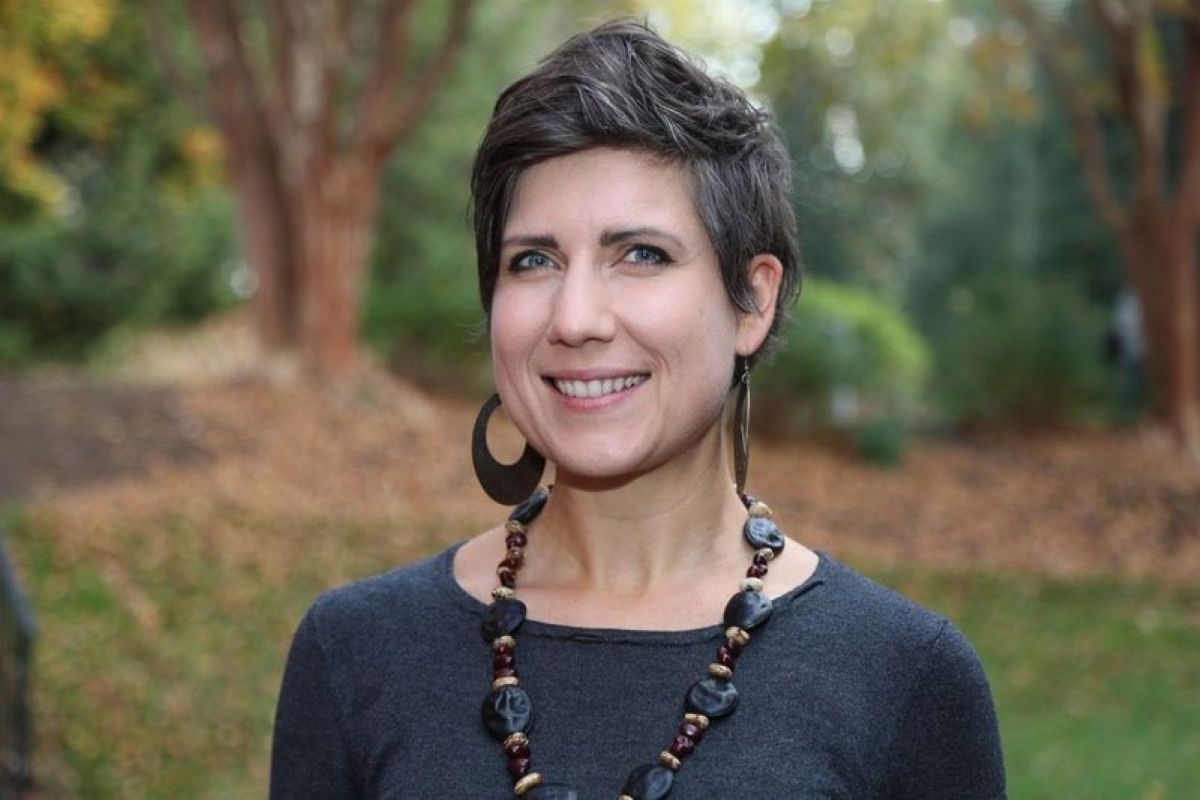
This month, we are celebrating Annette Luzius, mom of three and materials engineer, living in Sylvania, Ohio. She was nominated by Amanda Rowoldt, Moms’ Ohio Field Organizer.
It’s the rare person obsessed with home air quality. Annette has been thinking deeply about it since her days as a college student studying clothing technology. After earning her masters in textile engineering, she worked for more than a decade for a leading filtration company, tasked with, as she says, “filtering the useful from the harmful” in automotive and residential systems.
Then came motherhood. When she was pregnant with her first child 10 years ago, Annette researched furniture, paint, flooring, and baby products and learned about indoor air pollutants that can escape from all of the above into the air we breathe. These include volatile organic compounds (VOCs), formaldehyde, and other toxic chemicals, which can cause a range of potential health problems, from cancer to developmental disorders to hormonal and reproductive problems. Children and babies are the most vulnerable.
Annette began a serious search for low-emissions baby gear, quickly realizing there was very little public awareness around the quality of the air circulating through all our homes every day. Now, she is channeling her knowledge to engineer a whole-home filtration system that reduces pollutants not captured by the traditional heating, ventilation, and air-conditioning (HVAC) systems in the majority of households in the U.S.
Tell Congress: Protect Our Families From Harmful Toxic Chemicals
Annette shared her journey with Amanda earlier this year when she reached out about becoming more involved in Moms’ work to reduce air pollution from petrochemical and plastics facilities across Ohio. An outspoken advocate for clean air in the home and local communities, she shared with us her story full of entrepreneurial spirit and hopes for a pollution-free future.
What makes indoor air quality so important—and difficult to improve?
We spend the majority of our time indoors, so the quality of that environment matters. I wish more people understood that. And having a good HVAC filter doesn’t mean you’ve addressed every possible indoor air issue. HVAC filters are primarily designed to capture particles, but gases such as VOCs require a different approach—like ventilation or gas phase filtration.
This isn’t always particularly convenient. There are portable air purifiers you can put in individual rooms to help address gases, or you can ventilate. But if you ventilate, your outdoor air could be polluted as well. When we had all the wildfire smoke this summer, you couldn’t ventilate your house. You couldn’t even see the sun anymore; it was so dusty out there.
Why is it so hard to raise public awareness about air quality?
Pollution is invisible a lot of the time, and you can’t even smell some particles in lower concentrations. You can’t see it, and you will probably not get sick immediately. It’s a slow process.
Have you experienced any personal victories in advocating for cleaner air?
There are so many things we can do to prevent respiratory health issues. For me, it’s simply getting people curious. I recently had a conversation with a pregnant woman about VOCs, and she said, “I’ve never thought about them.” Ten minutes later, she was asking all about where VOCs could come from in the kitchen, the baby’s room, furniture, and so on. That’s a victory!
Curiosity is the first step to exploring solutions for indoor air quality. As a new mom, I had so many things going on in my head, the last thing I wanted to worry about was the filtration system. So now I am looking into engineering a whole-house solution to get rid of VOCs. Maybe some families are happy putting an air purifier in the nursery, and that’s it. But the baby is not just living in the nursery. The baby is where you are, around the whole house.
What would your vision for a whole-home solution to VOC pollution look like?
It would be integrated in the HVAC system most homes already have—the rectangular air vents in the floor and the ceiling usually have a cover on top of them. You could put a filter in there with enhanced activated carbon to get VOCs and other gases out. The good thing is people won’t really have to think about it because every time an HVAC is on, the air will go through those filters. They’d last for months until you replace them. In the end, my hope is you wouldn’t have to discard the filter; you could send it back to be recharged. It wouldn’t go to the landfill.
This solution is noiseless, and it doesn’t steal your space, like a portable air purifier does. It just disappears into an HVAC system and does what it has to do to get rid of the VOCs in your home.
Any advice on talking to friends and family about air quality to inspire them to take action?
It’s just starting a conversation and meeting people at their level. When I was working at a filtration company, I was working with an artist, and he liked to spray paint in his apartment. I gave him a sensor that counted all the particles in the air. I asked him to put it in his room while he was painting and look at it from time to time. He was amazed at how many tiny particles were floating around as soon as he started spray painting. The next thing he did was rent another room to do his artwork because he was concerned for his pets—and he got himself a mask.
Tell Congress: Protect Our Families From Harmful Toxic Chemicals