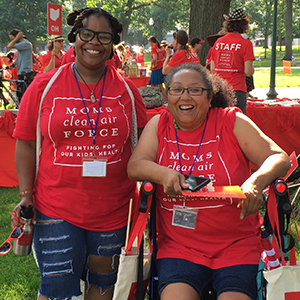

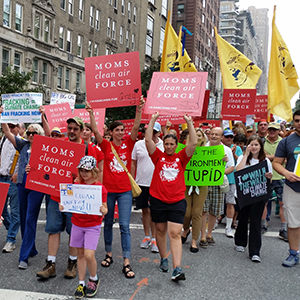


This April, Moms’ Shaina Oliver, a Tribal enrolled member of the Navajo Nation, and Liz Hurtado joined a who’s who of the top U.S. Tribal policymakers, regulators, and advocates for clean air at the 26th annual National Tribal Air Quality Forum (NTFAQ) in Tulalip, Washington. The event was cohosted by the Institute for Tribal Environmental Professionals (ITEP) and the National Tribal Air Association, which now includes 162 Tribes across the U.S. It spanned four days, with dozens of breakout sessions covering everything from best practices for setting up community air monitoring networks to how to navigate EPA’s Office of Air and Radiation to training sessions for improving indoor air quality in schools and daycares. All such critical work.
Liz and Shaina hosted their own presentation about how Moms Clean Air Force works to center Tribal sovereignty in our clean air advocacy. “For us,” says Shaina, “clean air is not abstract. It’s about whether families can breathe safely and whether communities can protect their land, culture, and future. Tribal Nations have long led efforts to protect air, health, and community well-being—often without the resources and support they deserve.”
Shaina and Liz emphasized the importance of standing alongside and in support of Tribes’ work on air quality, bringing in additional people power if needed to strengthen protections and advance shared priorities. Here are three of many incredible Tribal air experts from the forum doing compelling and impactful work in their communities and beyond.

1. Nikki Cooley
Originally from the Navajo communities of Shonto and Blue Gap, Arizona, Nikki Cooley is helping write the book on how global warming is impacting Tribal communities in the United States. It’s called the Status of Tribes and Climate Change Report, and the 242-page second volume, published by ITEP, came out last year. As a co-director of ITEP, a member of the report’s steering committee, and a contributing author, Nikki helped bring together Tribal knowledge and stories from across the U.S. to paint a comprehensive picture of not only how climate-driven extreme weather, drought, air pollution, and disease are affecting Tribes but what they are doing about it.
Nikki also leads ITEP’s Tribal Wellbeing for Seven Generations Program, based at Northern Arizona University. Under the banner of the seven generations principle, an Indigenous philosophy encouraging Tribal leaders to consider the impacts of their decisions on seven generations of descendants, the program offers support for Tribal resiliency programs and efforts to transition to cleaner energy, like solar and wind.
Follow Nikki Cooley on LinkedIn.

2. Anthony Smith
An Elder of the Nez Perce based in Lapwai, Idaho, Anthony Smith leads the Environmental Restoration and Waste Management division in the Tribe’s Department of Natural Resources. This division is primarily tasked with monitoring and helping to restore the Hanford Superfund sites in southeastern Washington, along the Columbia River. Although the site is about a three-hour drive from Lapwai, it is critical to the health of the larger Columbia River Basin, which spans Idaho, Oregon, Washington, Montana, Nevada, Utah, and Wyoming, plus parts of British Columbia.
The Hanford site was once the location of a large nuclear facility that polluted the river with discharged cooling water contaminated with radioactive and hazardous chemicals and polluted the soil with buried solid wastes. Anthony’s role is to ensure Nez Perce culture and treaty rights—which give the Tribe access to the Columbia River and its tributaries, like Snake River in Idaho, for fishing and hunting—are preserved in the ongoing cleanup.
Anthony, a gifted orator, gave closing remarks at the forum. He called on all Tribes to work together as family to protect and enhance our environment and human health. “There’s a light inside all of us, and it shines brighter when we travel together,” he said.

3. Randy Ashley
For nearly 30 years, Randy Ashley has led air quality programs for the Environmental Protection Division of Natural Resources for the Confederated Salish and Kootenai Tribes, based in Polson, Montana. In addition to increasing his Tribe’s soot pollution monitoring capacity, he implemented the Tribal Exchange Network (TRX) on his reservation to track pollution in real time. He has also previously served as the Tribal Co-chair of the Western Regional Air Partnership (WRAP), which facilitates communication between Tribes and the U.S. EPA.
He told Liz at the conference that these days he’s spending a lot of time thinking about data centers coming to Montana, including a cryptomining data center—which would store powerful computer processors to validate digital currency transactions—planned for his reservation. The data center planned for Polson is anticipated to run on renewable hydroelectricity from nearby Kerr Dam. But Montana utility NorthWestern Energy has already gone on record with its plan to supply 1,400 MW of electricity, enough to power 1 million homes, to three additional new data centers by 2030. A big percentage of this power is expected to come from the aging, expensive, and dirty Colstrip coal plant, which the Trump administration has exempted from mercury and air toxics protections. Randy’s work for cleaner air has never been more important.

Tell Congress: Protect Families From Dangerous Data Center Air Pollution