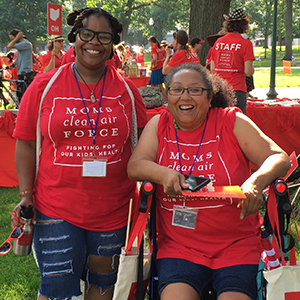

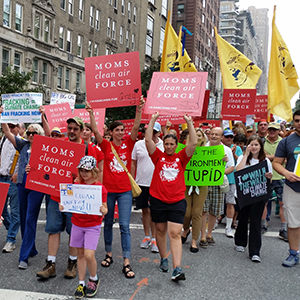
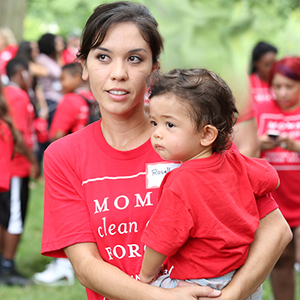


Each month, we highlight a new Supermom of the Month, a member who has gone above and beyond to advocate for clean air and children’s health. Our members in states across the country are more important than ever as we work to protect the hard-fought clean air and climate investments from attacks by the Trump administration. Will you join us?
This month, we are celebrating Amy Dishion, who has been volunteering with Moms since her daughter was born in 2022. Amy was nominated by Hazel Chandler, Moms’ former Arizona Field Organizer.
A little over two years ago, Amy’s husband, Evan, died of heat stroke after a hike with friends in Arizona on a 109-degree day. Since the tragedy, she has moved with her daughter to Oregon, where she continues to work to spread the word about precautions to take in extreme heat. This past year, she appeared as Moms’ special guest at a virtual town hall about how heat can impact health with Congressman Greg Stanton (AZ-4) and pediatrician Dr. Debra Hendrickson, told her story for an article on our website, and even traveled to New York City for Climate Week to represent Moms on a panel hosted by Extreme Weather Survivors about how people who have experienced horrific climate events can change narratives and force accountability.
Tell Congress: Protect Our Ability to Prepare for and Recover From Severe Weather Threats
We asked Amy a few questions about what the fight for climate and clean air protections means for her:
You have been through so much in the last few years. How do you stay motivated to continue advocating for the environment and public health?
I have always had an intrinsic drive to protect and advocate for our planet. I am in so much awe of our world and the beautiful creatures we share it with. However, sometimes I do get discouraged and feel like I might be fighting a losing battle when I am advocating.
When this happens, I look at my daughter and think about the planet she will inherit. I imagine my daughter’s children moving through the world. What sort of world will they live in? This fills me with determination to protect our environment.
Then I consider not just my child but all children, innocent and full of potential. I realize in these moments I must keep doing everything I can to protect our earth.

How did you first become interested in environmental and air quality issues?
When I was in college, I took a course called Environmental Health. In this course, I learned about air pollution and other forms of pollution and how they have affected people. I realized that many of the environmental issues we face today—pollution, extreme heat, water scarcity—are caused by humans and therefore can be solved by humans.
I started researching various ways I could minimize my carbon footprint—using the car less, swapping out lightbulbs, reducing my food waste. I learned in this class that legislation and policy can make or break our future on this earth. For example, the Clean Air Act of 1970 has been one of the most influential environmental laws in our country’s history. I want to see more legislative solutions like this one in the fight for our future as a species.
What do you think is the biggest challenge in raising awareness about air quality among the broader public?
The biggest challenge is the complexity of the issue. Health impacts of air pollution are often delayed. Asthma and other respiratory diseases associated with pollution may not appear for months or even years after exposure.
Fighting misinformation is also challenging. I think it’s important for me to continue learning how best to communicate with individuals from various populations, to meet people where they are and focus on what we have in common versus sitting in judgment.
Tell Congress: Protect Our Ability to Prepare for and Recover From Severe Weather Threats