


My Climate Job is our series about careers in fields that fight climate disruption or are impacted by the climate crisis.
Anyone can help in the war to rid the United States of plastic. It’s an all-inclusive crusade. Take political campaign media specialist turned actor turned producer John Charles Meyer. He founded Plastic Free America with a mission to reduce single-use plastic items in restaurants and quickly shifted to doing this work in schools across the country. To date, the organization has eliminated more than 19 million single-use plastic items from schools—and is nowhere near done.
Tell Congress: Protect Our Health, Not the Plastics Industry
The California-based dad of two isn’t compensated for his tireless work. “We are a 100% volunteer-run operation. I’m an actor when Hollywood lets me be one,” he says. He’s been in dozens of films and TV series. “I’ve also produced two feature films that still eat up some of my time long after their initial releases. So I spin a lot of plates.”
Just not plastic ones! Read on to learn more about how Plastic Free America is offering schools and restaurants across the country subsidies to switch to reusables.
How did you wind up launching Plastic Free America?
A friend opened a burrito shop in Hollywood in 2018. I plunked down my 12 bucks to support him, and as he made my lunch, I asked why half the takeout supplies behind him were plastic and half were plant-based. “Cost difference,” was the answer. “How much difference?” I asked. “I don’t know. You figure it out.” He handed me a sheaf of receipts, and I did some rough math: about $300 per month. That’s a sizable sum for a new takeout shop, but the idea of spending $300 to eliminate thousands of plastic items from the waste stream was tantalizing.
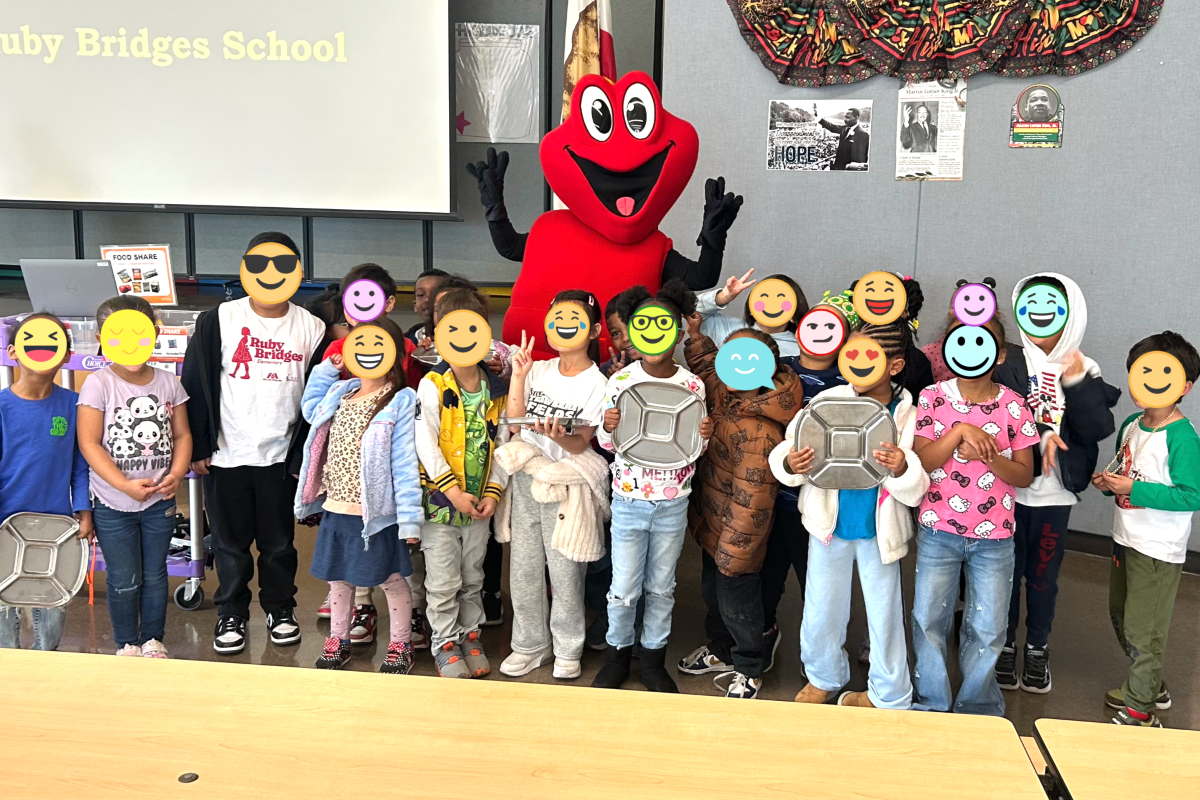
When we launched our nonprofit 18 months later, we were woefully ignorant of the fraught landscape that is single-use plant-based “compostables” (hint: PFAS chemicals), and we were equally clueless about the ripe target that was school cafeterias. It took a while to find our footing, but we have now eliminated more than 90 tons of plastic from 118 schools, 92 restaurants, and 20 other kitchens in 19 states, simply by purchasing reusable, mostly stainless steel, food ware. Doing so requires shockingly small sums of money: Just $28 worth of stainless steel forks eliminates 5,000 plastic forks from a school cafeteria every school year.
Why are schools easier than restaurants?
Schools are simply better targets for our efforts. They are closed systems—i.e., no takeout or delivery, they serve predictable numbers of meals from one month to the next, their students are more impressionable audiences than workers on lunch breaks at food courts, and the money saved from our efforts in schools is felt by taxpayers rather than by business owners.
Also, the health aspects of this issue are infinitely more compelling to parents and patrons than the environmental angle from which we started. If I tell a school board meeting that switching to stainless steel trays will help the planet, eyes roll back in heads, but if I tell that same meeting that polystyrene (foam) trays and polypropylene (plastic) forks are poisoning their children’s endocrine and reproductive systems, people snap to attention.
Is there a specific moment when you decided you wanted to have a climate job?
I spent my 20s in Washington, DC, juggling gigs with a political media consulting firm and a rock band. I spent my 30s in Los Angeles, juggling acting gigs and film-producing projects. I spent all that time mentally wringing my hands over the fact that I’d never done anything with my life that was beneficial in any way to planet Earth. The environment has been my number one political issue for as long as I can remember, but I wasn’t doing anything about it. When I finally had the spark for trying to eliminate single-use plastic in restaurants with relatively small sums of money, it was a no-brainer to run with it.
In your work, what are typical battles that come up?
When I started, I naively thought that the financial barrier of purchasing reusable food ware would be the biggest hurdle facing kitchens, and that removing that would make reusables an easy sell. It turns out the biggest obstacle we face is change. I hear this lament every single week: “This is how we’ve done things since we opened our doors—or since Covid. If we go reusable, then I’ll have to retrain my staff, or rearrange my kitchen, or change suppliers. And won’t I have higher labor costs?”
Every kitchen that washes its own dine-in dishes saves money by switching from single-use to reusable food ware, even after accounting for increased labor, water, and electricity costs. Every. Single. One. We have dozens of case studies proving it. Restaurants and schools simply don’t realize how much of their overhead cost is driven by things that are used for 15 minutes and then thrown out.
For the record, the second biggest hurdle is lack of dishwashing infrastructure. There are 98,000 public schools in the United States, and it is estimated that 35% of them have no ability to wash dishes. Our organization might save a school $4,000 or $5,000 by purchasing its stainless steel trays and utensils, but if it first needs to spend $80,000 to retrofit a kitchen, then it can be a tough sell.
What do you love about this work?
It is deeply satisfying every time I get to update the impact page of our website to reflect another 50,000-plus plastic items eliminated from the waste stream.
What’s hard about your work?
Not seeing governments step up and make our work irrelevant. Simple solutions to avoid poisoning kids by serving them lunches with toxic materials that then clog landfills while spending unnecessary tax dollars should be the most obvious priority for local governments, but very few of them take this issue seriously.
Will you expand?
We’ll be here until single-use plastic is gone from schools. We can’t not expand. We have a lot of ground left to cover: 118 schools down, 97,882 to go.
How can parents and caregivers get their schools to work with you?
Plastic Free America’s subsidy program is available to any food service establishment that currently gives single-use items containing either petroleum-based plastic or PFAS to its customers or students, is willing and ready to switch to reusables, and is not required by local, county, or state law to discontinue using the single-use plastic. Anyone—parent, teacher, principal, food service director, or student—can start an application, and the schools that successfully make the transition from single-use plastic to stainless steel are almost always the ones with a “squeaky wheel” on the inside.
To apply, simply gather the most recent three months (or more) of invoices for the single-use plastic you want to eliminate, and then fill out our application on this page.
Tell Congress: Protect Our Health, Not the Plastics Industry