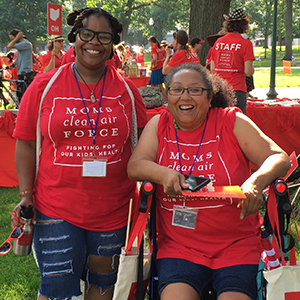

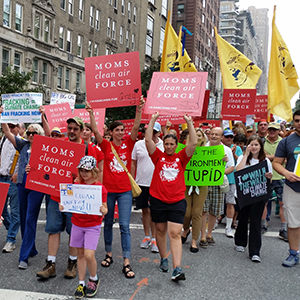


“This gathering is hopeful,” said Patrice Tomcik, Moms’ Senior Field Director, on Wednesday, March 4, kicking off our annual Moms Summit: Plastic on Our Minds and in Our Brains. The event featured scientists, doctors, journalists, and community members in three wide-ranging discussions of the latest scientific discoveries about petrochemicals’ dangers to our children’s health—and what we can all do to keep our communities and families safe, including taking action together. Here’s a brief recap.


1. The Plastics Playbook
In the first discussion of the day, Maria Finnegan, Moms’ National Field Manager, spoke with Mariah Blake, investigative journalist and author of They Poisoned the World: Life and Death in the Age of Forever Chemicals, and Dr. David Michaels, epidemiologist and professor, George Washington University Milken Institute School of Public Health, about how the plastics industry is working to convince the public their products aren’t unsafe. They delved into history. Paying scientists and economists to create doubt about the safety of chemicals is an old strategy. Dr. Michaels said “doubt science” has been used by many industries including tobacco, lead, vinyl chloride, and asbestos.
But doubt science only works for so long. “Finally the evidence becomes so overwhelming,” he said. This is what’s currently happening with synthetic chemicals, noted Mariah, whose work centers on PFAS forever chemicals found in everything from lipstick to dental floss to cellphones—and in all of our bodies. “The science is very robust … but the industry has so effectively sowed doubt that people don’t understand and continue to use products that are affecting health.”

There are ways to fight doubt science and safeguard human health. Though the companies making PFAS knew that they were toxic since the 1960s, the public only learned this because a family of West Virginia farmers sued chemical maker DuPont when their cows, exposed to PFAS chemicals, grew tumors and died. “Lawsuits have a huge impact,” says Dr. Michaels. They can eventually force polluting companies to shift behavior.

2. Unexpected Exposures and Dangerous Impacts: Petrochemicals Entering Our Lives
In a lively exchange moderated by journalist Amie Rivers from Iowa Starting Line—part of the Courier Newsroom, our media partner for the Summit—experts discussed routes and impacts of petrochemical exposure. They also addressed ways to protect ourselves, considering, as Cynthia Palmer, Moms’ Senior Petrochemicals Analyst, stated, “the problem is so vast that the plastic industry will triple by midcentury.”
Dr. Ray Dorsey, neurologist and director of the Center for the Brain and Environment at Atria Health and Research Institute, shared that brain disease is now disabling more people around the world than ever before. The causes are not in our DNA or genes, but in our environment, especially the air we breathe.
Dr. Dorsey, author of two books on Parkinson’s, is especially curious how we have gone from six to six million cases of the disease in 200 years. “It’s growing much faster than aging can explain by itself. It’s our environment. If we clean up our air, food, water, and cosmetics, we can get to something where what’s increasingly common is increasingly rare.”

Cosmetics are of particular interest to Dr. Jasmine McDonald, Associate Professor of Epidemiology, Columbia University. She also works to understand the health impacts of universal environmental exposures, noting “some are exposed more than others.” Women are more likely to be exposed to cleaning products in the home and chemicals in cosmetics, a $100 billion industry. Black women spend seven times more than other women on cosmetics.
“We are exposed to these chemicals because as a Black woman or Brown woman or Indigenous woman, we are told the standard of beauty is light skin and long straight hair,” said Dr. McDonald. “There are known human carcinogens in the products we probably started putting on our hair before we could even go to kindergarten.”
While federal public health protections are being dismantled, states are leading the way on chemical safety. When it comes to getting ingredients like phthalates, plastic chemicals linked to endocrine disruption, out of cosmetics and even IV tubing, Dr. McDonald said, “Always look to California as one of those huge stages trying to push. Be concerned not just in your own state.”

3. From Appalachia to Louisiana, Real People Fighting Petrochemical Polluters
Community members are critical when fighting petrochemical pollution. That was the theme of our final Summit talk with Martec Washington, Black Appalachian Coalition Community Organizer, and Robert and Tish Taylor, the father-daughter duo from Concerned Citizens of St. John, moderated by Lani Wean, Moms’ West Virginia Field Organizer
While Martec lives in West Virginia (Cancer Valley) and Robert and Tish are in Louisiana (Cancer Alley), their stories and advocacy are shared. Robert, born in St. John, Louisiana, in the 1940s, can still recall when the local industry transferred from agrarian (sugar cane) to petrochemical. While community health problems emerged, like an increase in cancers and respiratory illness, they didn’t realize until much later that the petrochemical industry was responsible for these, plus changes in their environment. “Plants, trees, animals were no longer there. We lost our fireflies,” he shared.
In 2016, EPA came to St. John Parish, held conferences, and set up a monitoring system; a likely human carcinogen used to make neoprene coming from the nearby Denka plant (formerly owned by DuPont) was being released at 400 times the EPA allowed amount, and there were 400 to 500 Black children at an elementary school just 1,000 yards away. “I was flabbergasted that people were doing this and we were all so unaware,” Robert said. So he founded an organization and took action to stop it.
Martec had a similar feeling in West Virginia. “At no point did I know I was being poisoned,” he said. He loved growing up there, with his school along a river he didn’t know was unsafe. “It was wonderful. Looking back, am I going to have cancer? What type of disease am I going to have solely because I live here?”
Tish, who hosts The Good Neighbor Podcast, shared that her brother had kidney disease at three, her grandmother and mother both had cancer, her sister has both gastroparesis and a rare autoimmune disease, and her grandson was born premature and is autistic. “I was devastated. It was the government letting this happen right before our eyes. It wasn’t really the petrochemical industry; it was the people supposed to regulate them. The Clean Air Act is pretty straight forward,” she said.
Currently, laws passed under the Biden administration to help these communities are being rolled back and polluters are being given extensions to adhere to those still in place. The fight continues.

While the challenges posed by the petrochemical and plastics industry are real, so is people power. In her closing remarks Celerah Hewes, Moms’ Senior Field Manager, said “All of us can hold decision makers accountable. When we stand together, change happens. These are preventable toxic exposures, and the future is worth working for. Let’s keep going.”