



“People are hungry for stories of progress,” says Amanda Leland, describing her new book, Sea Change: Unlikely Allies and a Success Story of Oceanic Proportions. It’s a story about fishing and oceans, but really, it’s about how people who didn’t agree came together to find a common path forward on a difficult issue—fisheries management—that no one thought could be solved. “That’s the big theme,” says Amanda, Executive Director of the Environmental Defense Fund (EDF). Successful advocacy work of any kind, including climate work, has to involve coalition building and working within communities, not just outsiders working alone on an issue. Sea Change offers a unique example.
Tell Congress: Defend EPA’s Ability to Protect Human Health and the Environment
The tale of the decade-long transformation of U.S. fisheries starting in the early 2000s, and the new strategy that improved the health of fish stocks and kept them from collapsing is told through a legendary Gulf of Mexico fisherman, Keith “Buddy” Guindon. “He was the biggest opponent, and then he was the biggest champion—a hero but not the hero you anticipate,” says Amanda, who co-wrote Sea Change with James Workman, formerly of EDF. The organization was a catalyst for adoption of the new strategies that enabled fishermen to keep fishing.
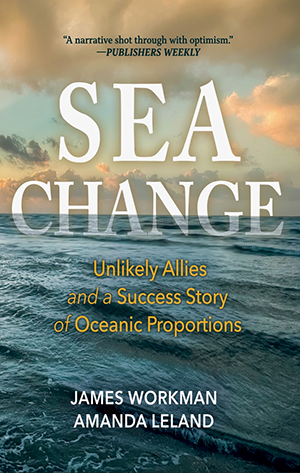
Along with Buddy’s saga, the book is full of history, fish lingo (catch shares, no take zones, marine protected areas), and eye-popping statistics (America imports 79% of seafood). Readers will learn there’s a fish called a cowcod. The book also touches on global fishing concerns; governments may try to impose borders on oceans, but water and aquatic life are, in essence, borderless.
Climate change and impacts on fish
The oceans are the main absorber of heat on the planet, and marine species have a pretty specific thermal tolerance. “They have evolved to be in the world that exists today, but they have not yet evolved to be in the world that exists tomorrow,” says Amanda. As waters warm, fish are physically moving, crossing jurisdictions to seek comfortable temperatures. “Typically, the people most reliant on seafood are living in the tropics and are the most vulnerable. They have very few other options for local food sources. If you live on an island in Indonesia, you can’t just start raising cattle,” she notes. Fish, full of nutrients, are a low-carbon source of food. Now, they’re moving to places with cooler waters that have alternative foods and are more wealthy. “This has equity implications,” Amanda notes.
Fishing, efficiency, and air pollution
The biggest factor in the balance sheet of fishermen is the cost of fuel, Amanda says. Slowing the pace of fishing down enough to allow fisheries to recover resulted in a reduction in diesel usage. “If you slow the frenzy down, fishermen can actually run their engines more efficiently, improve engine quality, and use a lot less on fuel,” she says. Still, diesel used in fishing boats isn’t an outsize amount; there aren’t a huge number of them in the world, and some are quite small. “Even on industrial fishing boats in Alaska, where they get the fish for your McDonald’s Filet-O-Fish sandwiches, they use every part of the pollack, including the oil, which they burn as part of their fuel,” she says.
Unregulated plastic pollution and ocean health
Scientists are reporting microplastics found in everything in the oceans. But this hasn’t changed the nature of the seafood industry, says Amanda: “Heavy contaminants like mercury, yes, but there isn’t really clear evidence about what long term exposure to microplastics does to humans.” To her mind, plastic must be tackled upstream to keep it from being an ocean problem. “We are going to clean it out, and it’s just going to keep coming. Until we stop plastics from getting down rivers, it’s not going to stop flushing out into the oceans.”
Can the current administration roll back the success story described in Sea Change?
The Trump administration has been steadily clawing back—or trying to—environmental protections in America. While fisheries management can be rolled back in “extreme circumstances,” Amanda notes that the practices described in Sea Change have now already survived multiple administrations with very different politics. Critically, she notes, it’s not only environmentalists who want the management; it’s fishermen too. When fishermen have an incentive for sustainability and are rewarded for staying within limits of amounts they can catch, it works. “You could change the regulations, but as long as fishermen have a financial rewards approach for conservation and they are all operating under that same approach, it sticks,” she says.
Users vs. Savers: Lessons for the environmental movement
Engaging fishermen as stewards to tackle overfishing can translate to the broader environmental movement in many ways, particularly for natural resources where you have people who have historically used the resource and want to continue: farmers, loggers, hunters, ranchers but also the business sector, technology, and clean air in general. Sea Change recounts what happens when things get so bad that environmentalists (savers) and fishermen (users) need to form an “unholy alliance” as strange bedfellows saving fish. This core promise of future yields can get savers and users of any natural resource to collaborate, especially when the needs of the people directly impacted are centered.
This is ultimately how fishermen, long suspicious of academics, came to work with them to find solutions that work for people and communities in their everyday lives that also work for the planet. “That’s where we see lasting progress and a road map for other environmental issues going forward,” says Amanda. She hopes Sea Change will help open people’s minds when it comes to problem solving, especially the minds of decision- and policymakers, as well as people who care about the environment and all natural resources, not just oceans.
Sea Change comes out September 30, 2025. For 20% off, use the promo code BUDDY at the publisher’s website.
Tell Congress: Defend EPA’s Ability to Protect Human Health and the Environment