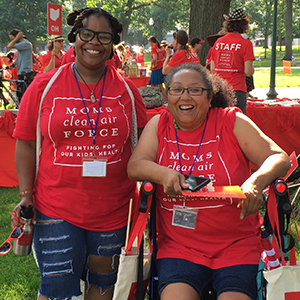

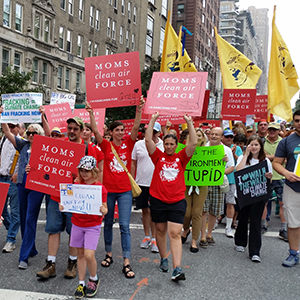
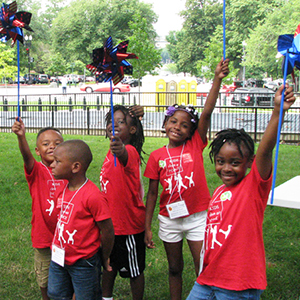

Each month, we highlight a Super Volunteer of the Month, a Moms member who has gone above and beyond to advocate for clean air and children’s health. Our members in states across the country are more important than ever as we work to preserve clean air and climate protections. Will you join us?
This Mental Health Awareness Month, we are celebrating Addie Navarro, a mom of two, wilderness instructor, and educator based in Durham, North Carolina. Moms’ Field Organizer Ashley Hillard nominated Addie after she taught her workshop, “Parenting Climate Resilient Kids: An Anxiety-Free Roadmap for Raising Kids to Thrive in an Uncertain Future,” at a recent event.
Tell Congress: Support Mental Wellness Resources for Communities Facing Weather Disasters
We talked to Addie, a self-described educational pedagogy and philosophy nerd, about her plans to open a nature-based preschool, her framework for dealing with eco-anxiety, and her efforts to raise conscientious kids.
How did you first become interested in environmental and climate issues?
It started from a place of recreation, going on hikes with my family in Colorado, before we moved to North Carolina. And I went on backpacking trips in high school that were transformative experiences—a total immersion in nature that expanded what I thought I was capable of. After having these experiences, when I finally did understand climate change, it clicked in a big way. We were talking about places that I had been and had loved.
What does climate advocacy look like in your life?
Right now, I’m focused on raising the next generation of climate advocates, acting as a bridge between where we are now and where we want to go. How do we teach children who can be resilient and live in a way that doesn’t exacerbate climate change?
I’m starting a nature forest preschool here in Durham in August. Right now, I’m setting up the space—part here in my garden and then part at the local state park. I want kids to be educated so that even from their first experiences, they are immersed in and love the natural world—because I think that’s what comes before climate advocacy.
Tell us about your Parenting Climate Resilient Kids workshop.
A lot of times the stories we tell kids about climate change are scary. That can be appropriate as kids get older, but there’s a way of introducing these topics without crushing hope too early. My worst nightmare would be for a kid to grow up learning about climate change and then as a teenager say, “What’s the point? I don’t care. We’re cooked.”
My motivation for the workshop was to talk to other parents and educators about how we can fix our own mindset so that we’re not giving our kids anxiety and distress. It’s designed to ground parents and educators in the here and now and then offer tangible actions they can take to prepare children to adapt to different climate-related scenarios.
How do you manage your own eco-anxiety?
For me, eco-anxiety really clicked on when my son was born. A week after the birth, this wild 15-minute storm came through and knocked out our power for a few days. We were home—sweating with no power in August—with this newborn and scared.
So I created a framework of how I think about climate anxiety. There’s a grieving process that needs to happen, and maybe we’re always holding a little bit of that grief. Then there’s an action element—doing things that are creative and action-oriented, like gardening—and community building. I’ve found a lot of solace in anything that I can pour into my community, and by that, I mean my literal neighbors. Everything I give I get back 50-fold, and this reciprocity reminds me that we have more power as a collective. We’re here for each other.
What role do you think moms and caregivers play in addressing the climate crisis?
I think everything—it’s probably the most central role. Anybody who has contact with kids makes a difference. You are setting the stage for the world after we’re gone. As a parent, you have a ton of power to normalize sustainable practices for your kids. In our house, we like to garden and compost; my kids are not going to have to learn these skills as adults. This could look different in every house. But the important thing is bringing them along with us on our journey to living a sustainable life.
Also, we should not underestimate the power of raising kids who can be kind and cooperate with other people. Will they have the skills to build community with other people? My two-year-old doesn’t yet, but hopefully he will.
Tell Congress: Support Mental Wellness Resources for Communities Facing Weather Disasters