


This resource has been factchecked by policy experts, using the latest scientific research. Find all our sources linked below.
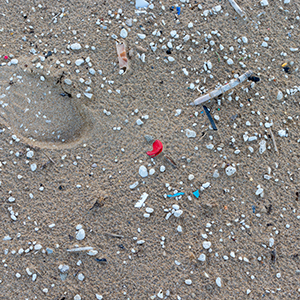
Microplastics are tiny particles of different kinds of plastic that come from many sources. At less than five millimeters in size, most are jagged with sharp edges and are too small to see. It is the smallest ones that are the most dangerous since they can penetrate cell membranes, induce inflammation, and disrupt metabolic processes. The tiniest of plastic fragments, called nanoplastics, are smaller than one micron, cannot be expelled by the body, and are far more abundant and dangerous than the larger microplastics.
Our air is dense with microplastic pollution, which can travel thousands of miles in mere days or weeks. People can inhale millions of tiny plastic particles per year. Microplastics can also penetrate skin pores, and we ingest them when our food and beverages contain them. A single one-liter bottle of water contains an average of 240,000 microplastic fragments suspended in the water.

A blue rectangular piece of microplastic is visible on the finger of a researcher. (Ted S. Warren, AP)
Sources of microplastics
Microplastics can come from anything plastic, small or big.
There are plastics intentionally made to be small, like the pellets, called nurdles, that are the building blocks of larger plastic items. Some companies put microplastics into their products, including in toothpaste and cosmetics like face scrubs, lipstick, and nail polish.
Some microplastics break down from big pieces of plastic, like bottles, which degrade into tiny bits over time. Other sources of shedding microplastics include synthetic clothing (roughly half of textiles are made from plastic fibers such as nylon and polyester), plastic carpets and rugs, plastic furniture and construction materials, and items like fishing nets, food wrappers, paint, and synthetic tires as they wear down on roadways and as the old ones degrade—approximately one billion tires are discarded annually.

The tiniest of plastic fragments, called nanoplastics, are smaller than one micron.
Where are microplastics found?
Microplastics have been found in every ecosystem on the planet, including in the most remote locations. They pollute the polar regions, the deepest parts of the ocean, and even the top of Mount Everest.
Nearly everyone has microplastics in their body. Researchers have found these plastic fragments in the brain, breast milk, the placenta, baby poop, testicles, semen, blood, hearts, lungs, livers, kidneys, urine, and saliva.

Microplastics and human health
We know a lot about the health impacts of plastics, which are made from harmful chemicals such as phthalates, PFAS, and heavy metals. It is problematic that heavy concentrations of plastic fragments are embedded in humans and our environment. For example, a recent study found that the average adult brain may contain as much plastic as is found in an entire plastic spoon. This is a 50% increase from just eight years ago. Microplastics accumulate in fat tissue and act like slow-release drugs, leaching chemicals over time.
Research on the health effects of microplastics is continuing to emerge. Studies link microplastics to cancer, intestinal disease, pulmonary disease, reproductive dysfunction, and inflammatory diseases that can provoke further cancers. A recent landmark study found that people with microplastics in the plaque clogging their neck arteries were far more likely to experience a heart attack, stroke, or death than those without microplastics in their arteries.

Microplastics and community impacts
Plastics production, transport, and waste disposal facilities release vast amounts of microplastic pollution into surrounding communities via spills, leaks, and direct discharge into waterways. In the U.S., these facilities are largely concentrated in marginalized neighborhoods in the Gulf South and the Ohio River Valley. These communities are also forced to breathe extremely high levels of toxic air pollution from plastics facilities.
Among the worst sources of microplastic pollution are plastics recycling facilities. Researchers found that even with high-tech filtering, approximately 6% of the mass of plastic waste brought in for recycling was discharged as microplastics in the wastewater. Without new state-of-the-art filters, the amount released as microplastics was a whopping 13%.
Perhaps the very highest concentrations of microplastics are found in the Global South, in the countries that have become the world’s dumping ground for plastic waste. The U.S. and other countries export enormous quantities of plastic trash to such countries as Mexico, India, and Malaysia. Officially, U.S. plastics exports count as recycling, but in reality, most of this plastic gets piled in trash mountains, buried, or incinerated. The effects on human health and the environment are cataclysmic.

Ways to minimize exposure to microplastics
It’s almost impossible to avoid microplastics, but anyone can reduce exposure by minimizing the amount of plastic in daily life. This includes choosing natural fibers over synthetic ones for everything from clothing to carpets, and ditching plastic in the kitchen. Use glass containers for beverages and food items. Be wary of food items with high levels of microplastics, such as salt, tea bags, and rice.
At a minimum, avoid drinking hot liquids in plastic, never microwave plastic, and hand-wash plastic items rather than putting them in the dishwasher. Cleaning frequently using a vacuum with a HEPA filter and wet wiping surfaces are key ways to minimize microplastics in dust at home. This is especially important if you have a crawling, finger-sucking baby.

Take action
The amount of microplastics is increasing exponentially. It should not be up to individuals and families to try and dodge the onslaught of microplastic particles. We need to address this problem at the source. Join Moms Clean Air Force to demand that our elected officials support policies to cap and reduce plastic production and hasten the transition to reuse, refill, and repair systems.
Learn more about Moms’ work on plastics and petrochemicals.
Full list of sources.
Released: May 2025