

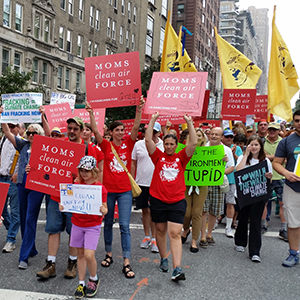


The comments are in. The docket is closed. The EPA will now consider the thousands of  comments that were submitted by the public about its proposed Mercury and Air Toxics Standards – also known as the National Emissions Standards for Hazardous Air Pollutants for Coal- and Oil-Fired Electric Utility Steam Generating Units.
We’ve worked hard to mobilize moms and dads to write to the EPA about the proposed rule, so we’re taking a deep breath today. But we are not relaxing. EPA’s rule, while a significant improvement over the status quo, has a long way to go before it is implemented. Each day that it’s not, excessive mercury and hazardous air pollutants are emitted by power plants into the sky. There they begin a strange journey as health-damaging pollutants.
While the EPA considers its docket of comments, I will consider mercury. What’s really at stake?
Mercury occurs naturally in coal. In the absence of effective pollution control technologies, mercury is released into the air when we burn coal for electricity. Power plants are the largest source of mercury pollution globally, and release about 50 tons of mercury per year. Other sources of mercury pollution include cement plants, chemical plants (especially chlor-alkali plants, which convert salt to lye and chlorine gas), metal smelting, and small-scale mining. But power plants are the largest source. If you live in a region where coal supplies some of your electricity – and coal supplies the US with about half of its electricity, so it’s very likely that you do – then your cell phone charger, your kitchen fan, and your reading light all contribute to mercury pollution globally.
Once in the air, mercury travels on air currents throughout the world and precipitates out over water bodies and land. Think of it as an invisible powder that is falling everywhere. In water bodies, that elemental mercury is chemically changed by microorganisms into methylmercury (this is known as “methylation” of mercury). Methylmercury then moves through the ocean’s vast food chain and “bioaccumulates,” or concentrates, in the bodies of animals. Fish that eat other fish have greater quantities of the pollutant, and the top-level carnivores, such as tuna, shark, whales – and people – have the most.
Although elemental mercury is toxic to humans (“mad hatters” referred to the mental disturbances that plagued milliners who used elemental mercury in their hat making), methylmercury is the most toxic form of mercury to people. It passes readily from the food we eat into our blood and brains, and is toxic to the nervous system. But it is not just toxic to the nervous system. It is also a neurodevelopmental toxicant, which is the medical term for a substance that interferes with brain development.
This is a key distinction. According to Phillipe Grandjean and Philip Landrigan, top researchers on the adverse effects of mercury and lead, respectively, in children, more than 1,000 chemicals have been shown in laboratory studies to harm the nervous systems of animals. In a subset of this group, 201 chemicals have been shown in clinical and epidemiological studies to be harmful to the brains of humans. And in a further subset of known neurotoxicants, a total of five chemicals are known to interfere with brain development: lead, polychlorinated biphenyls (PCBs), toluene, arsenic, and mercury.
Thus mercury has a special status as a chemical known to damage fetal brain development, one of only a handful of industrial chemicals that can claim such status. It’s not just that mercury is toxic to the nervous system. Mercury has the unusual capacity to cause irreversible harm to the complex architecture of our babies’ brains as those brains are developing.
It’s a punch in the gut for all parents. From the coal fired power plant to your baby’s brain.
I’ll address the specific health problems linked to methylmercury exposure in subsequent posts.